Gemini Omni 1.1 Flash lets you build with more control
Google released Gemini Omni 1.1 Flash, a developer-focused update to its generative video model, adding scene extension, frame interpolation, and 4K output for professional video workflows.
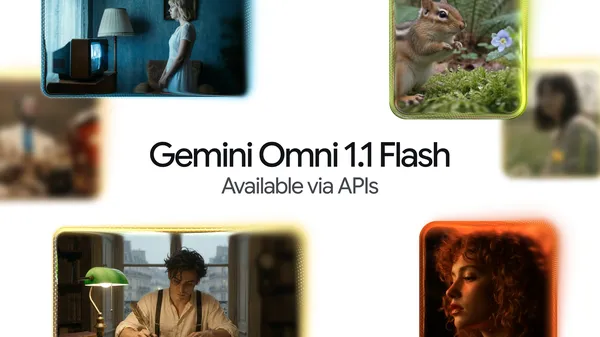
Google has launched Gemini Omni 1.1 Flash, a production-ready update to its generative video model designed for developers. The new version introduces scene extension, allowing users to continue generating video seamlessly from existing clips. It also supports first and last frame interpolation to create smooth transitions between shots. The model now accepts up to 10 seconds of prior context, improving visual consistency and narrative coherence in extended sequences. Developers can access the model through Google AI Studio or the Gemini Enterprise Agent Platform.
The update includes tools for precise camera control, enabling users to specify start and end frames for transitions such as zooms, orbits, or whip-pans. This feature supports complex camera movements while maintaining continuity, ideal for professional video editing and generative workflows. The model can generate continuous video between keyframes, ensuring seamless integration into existing production pipelines. These capabilities are intended to streamline creative video development for developers building media editing or generative video software.
Gemini Omni 1.1 Flash introduces faster and more cost-effective prototyping with lightweight 360p previews, generated up to 60% faster and at one-third the cost of standard 720p outputs. This feature is aimed at accelerating iteration during storyboard development and early-stage testing. The reduced cost and speed make it practical for developers to experiment with multiple ideas before committing to higher-resolution renders. The previews are generated through the same API used for standard outputs, ensuring consistency across workflows.
The model now supports high-resolution outputs of 1080p or 4K, suitable for professional production environments. These polished outputs maintain sharp details and dynamic range, aligning with industry standards for broadcast and post-production. Google positions this update as a step toward making generative video more controllable and deployable in real-world applications. The 4K capability expands the model’s utility for creators requiring high-fidelity footage without additional post-processing.