Korea Advances Physical AI Across Industries With NVIDIA
NVIDIA partners with Korean firms Samsung, Kakao Mobility and LG Electronics to deploy physical AI in semiconductors, autonomous vehicles and robotics, accelerating real-world production workflows.
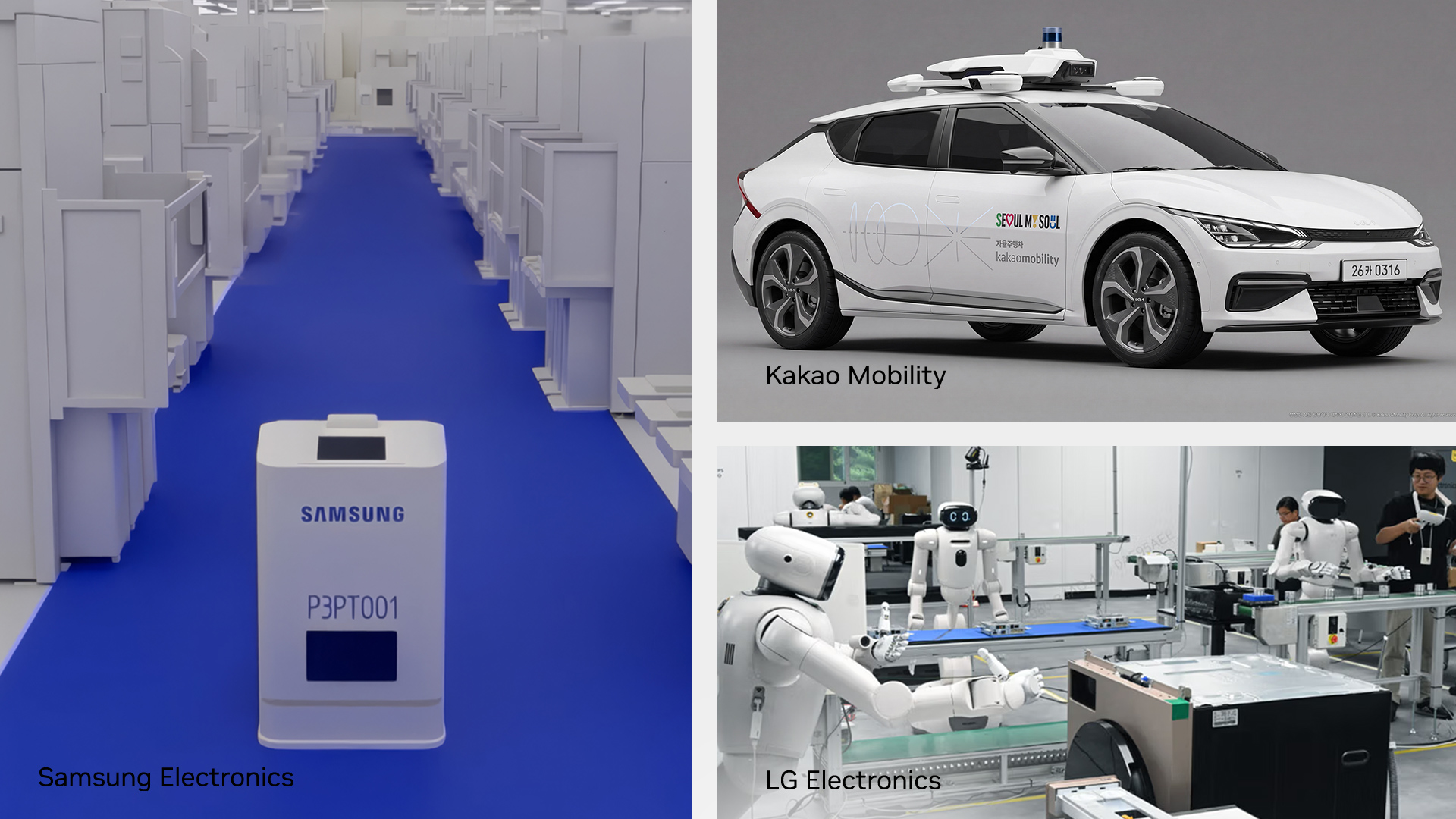
NVIDIA is collaborating with Samsung Electronics to integrate accelerated computing and AI into semiconductor development, covering materials research, process engineering and device design. The partnership uses NVIDIA tools such as cuISS, cuDSS and cuEST to speed up simulations and quantum chemical calculations, with reported end-to-end performance gains up to five times faster. Samsung is also testing NVIDIA cuEquivariance for tensor operations in atomistic AI models and developing chip-scale thermal and mechanical analysis workflows with NVIDIA PhysicsNeMo. In one case, combining AI predictions with GPU acceleration reduced simulation time from 18 hours on a 32-core CPU to 41 seconds.
Kakao Mobility is advancing a level 4 autonomous driving system by combining its proprietary software with NVIDIA’s vehicle computing platform, including NVIDIA Hyperion and DRIVE AGX Thor. The initiative integrates Kakao Mobility’s experience in Seoul’s Gangnam district and will use NVIDIA Halos for safety validation. Development will focus on Kia purpose-built vehicles, with the goal of enabling future level 4 mobility services in Korea.
LG Electronics and NVIDIA demonstrated robotic manipulation and manufacturing tasks using LG’s CLOiD robot powered by NVIDIA Isaac GR00T in an actual factory setting. The collaboration established a physical AI data flywheel that links real-world data collection, NVIDIA Cosmos-based augmentation, GR00T model training and Jetson AGX Thor onboard computing for reusable workflows.
The broader effort in Korea leverages the country’s manufacturing and engineering strengths to transition physical AI from development to production across industries. NVIDIA’s partnerships aim to create repeatable processes for training, evaluating and deploying AI-driven systems in real-world environments.