Agentic Analytics: Building a Data Foundation for AI Agents
Snowflake outlines a platform foundation for AI agents to autonomously investigate business questions, execute iterative analysis, and trigger governed actions within enterprise workflows.
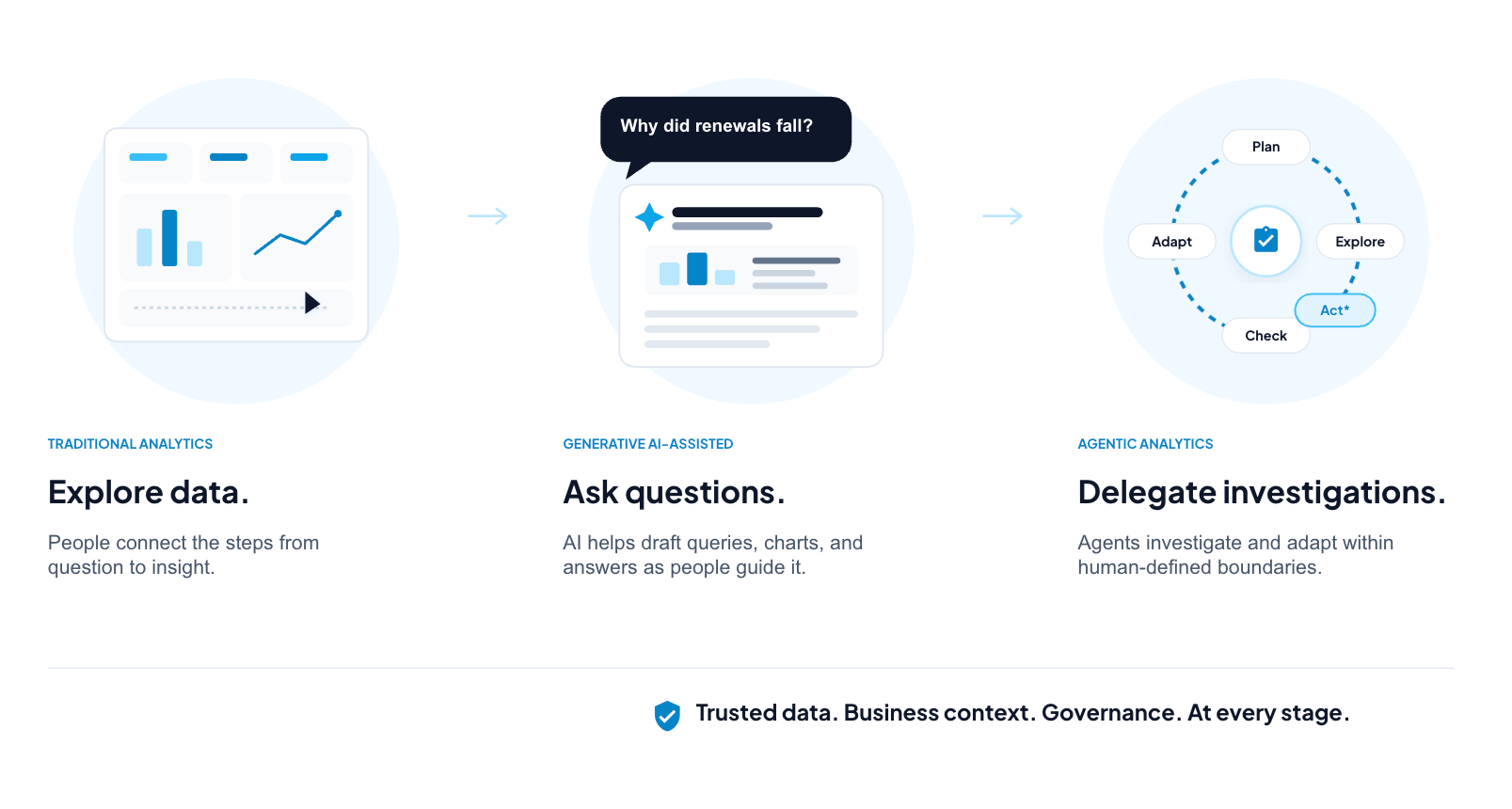
Agentic analytics represents a shift from static dashboards and AI-assisted summaries to AI agents that independently investigate business questions by selecting data sources, testing hypotheses, and refining queries until they reach a conclusion or recommended action. For example, an agent could analyze customer churn by comparing segments, reviewing product usage patterns, and examining support tickets, then escalate findings to a retention workflow without manual direction at each step. This approach requires a data platform capable of supporting unpredictable analytical paths, enforcing access controls, and enabling actions that integrate with existing business processes. Snowflake positions its platform as the environment where these requirements converge, bridging enterprise data and agentic decision-making.
To enable agent autonomy, Snowflake emphasizes three platform pillars—Ground, Analyze, and Act—each supported by governance capabilities under the Assure framework. Ground ensures agents access trusted business context through semantic views, certified metrics, and data freshness indicators, while Analyze provides optimized query execution, cost controls, and concurrency management tailored to iterative investigations. Act focuses on persisting outcomes and evidence in Snowflake, allowing applications to review and act on recommendations while maintaining control over consequential decisions.
Snowflake’s approach avoids forcing agents into a single application stack by using interoperable interfaces such as the Model Context Protocol (MCP), semantic views, and SQL objects to let authorized agents discover and analyze enterprise data without duplicating it across platforms. This design allows sales, finance, engineering, and support teams to adopt different AI assistants while keeping business context, analytical execution, and governance centralized near the data. The platform applies data access controls consistently, whether agents are built on Snowflake or connected from external systems, ensuring permissions and spending limits remain enforced throughout the investigation.
The platform’s governance layer, Assure, records agent-driven queries and data access, tracks compute spending, and enforces access policies attached to the data itself. This enables teams to review agent activity alongside workflow outcomes, supporting accountability for decisions that impact business processes. By connecting trusted business definitions, optimized analytical execution, and governed handoffs to business applications, Snowflake aims to reduce manual coordination while maintaining human oversight for consequential actions.