Countries far from conflict paying the price for wars not their own, India tells UN
India’s External Affairs Minister warned at the UN that distant conflicts impose heavy costs globally, urging restraint and accountability while highlighting terrorism and multipolar shifts.
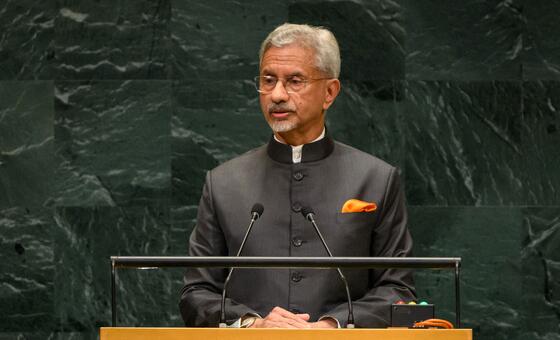
India’s External Affairs Minister Subrahmanyam Jaishankar told the UN General Assembly that countries far from conflict zones are bearing the economic and security costs of wars they did not start, undermining global stability and development. He emphasized that prolonged violence in regions such as the Gulf and West Asia is disrupting energy and trade flows, while maritime security threats endanger international waterways and civilian crews. Jaishankar reiterated India’s call for a two-State solution in West Asia and condemned State-sponsored terrorism, stressing that perpetrators must be held accountable under a zero-tolerance policy. He also highlighted India’s development contributions, including 600 projects in 78 countries, and warned that the post-1945 international order is struggling to adapt to new multipolar realities without excluding large parts of humanity.
Addressing the UN’s 81st session, Jaishankar described the global situation as increasingly unstable, with conflicts in Ukraine and the Middle East prolonging humanitarian and economic crises that transcend borders. He noted that the weaponization of finance, supply chains, and technology is deepening divisions, particularly affecting food, fuel, and fertilizer access in the Global South. The Minister stressed that terrorism remains a direct threat to peace, singling out State-sponsored cross-border terrorism as a violation of the global order that demands firm international action. Jaishankar also criticized attempts to normalize terrorism, calling for perpetrators to cease such activities and uphold accountability.
Jaishankar drew attention to the fifth year of the war in Ukraine, framing it as a persistent challenge to international peace and security that requires urgent resolution. He echoed Prime Minister Narendra Modi’s call to shift from endless conflict to ending war, reaffirming India’s support for peace initiatives and diplomatic efforts to restore stability. The Minister warned that a world dominated by threats and pressure risks destabilization, urging a return to stability, security, and predictability as fundamental priorities. He lamented that eight decades after the UN’s founding, these principles are being eroded by growing hyper-competition and institutional weaknesses.
The Minister also outlined India’s development progress, noting that its digital public infrastructure has advanced socioeconomic benefits for one-sixth of humanity. He highlighted India’s role in supporting 600 development projects across 78 countries, covering clean energy, infrastructure, sustainable agriculture, and information technology. Jaishankar acknowledged the challenges of adjusting to a multipolar world, cautioning that the transition will not be straightforward and requires inclusive dialogue to prevent exclusion of large populations. He concluded by stressing that civilized dialogue is essential to navigate the evolving global order.