Navigating a Synapse Migration to Databricks
Databricks outlines a phased approach for migrating from Azure Synapse to its Lakehouse platform, emphasizing structured discovery, assessment, and pilot phases to manage complexity across Dedicated SQL, Serverless, and Spark pools.
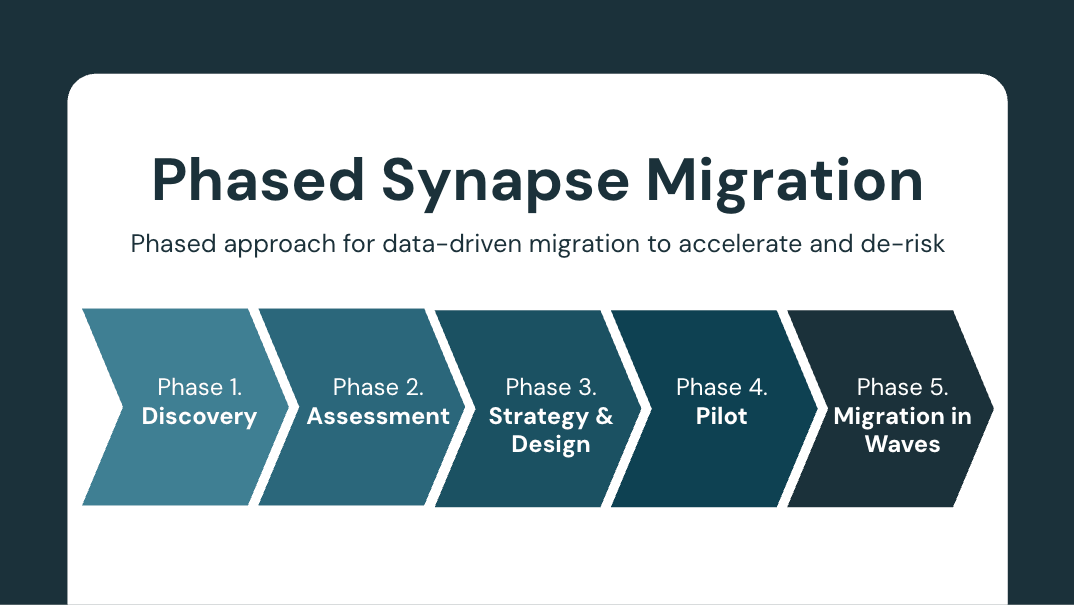
Azure Synapse has been a common choice for SQL analytics, but its limitations for modern data workloads often lead to added services and operational overhead. Migrating to Databricks Lakehouse consolidates these functions into a single platform governed by Unity Catalog, reducing architectural complexity. Early adopters like Casey's and Italgas report significant improvements, with Casey's cutting data delivery times from eight hours to four and Italgas reducing workload costs by 73% while supporting Power BI and AI-driven analytics.
The migration process requires careful planning due to Synapse’s multi-service structure, which includes Dedicated SQL Pools, Serverless SQL Pools, and Spark Pools, each with distinct migration strategies. Dedicated SQL Pools often present the highest complexity, involving business logic, stored procedures, and performance optimizations accumulated over years. Serverless SQL Pools and Spark Pools are generally simpler to migrate, as they rely on query layers and Apache Spark compatibility, respectively.
A successful migration involves structuring the effort into distinct phases: discovery, assessment, design, pilot, and wave-based execution. Tools like Lakebridge Profiler and Analyzer help inventory and evaluate Synapse estates, while a hybrid approach—combining lift-and-shift with incremental modernization—often proves most effective. Sequencing migrations to prioritize business-facing workloads can demonstrate early value, with Databricks Genie enabling natural-language analytics for end users.
Databricks supports migrations through advisory services, certified partners, and automation tools like Lakebridge, which handle up to 90% of code conversion. The remaining effort focuses on refining procedural logic and adapting to differences in syntax, such as removing Synapse-specific optimizations like HASH distribution in favor of Databricks’ Predictive Optimization and Liquid Clustering. Open storage formats allow integration with third-party ingestion tools, ensuring flexibility in data pipeline design.