Using AI_Functions in Your Data Warehouse: Top Use Cases
Databricks introduces AI Functions in SQL to process unstructured data directly within the data warehouse, eliminating external pipelines and reducing governance risks.
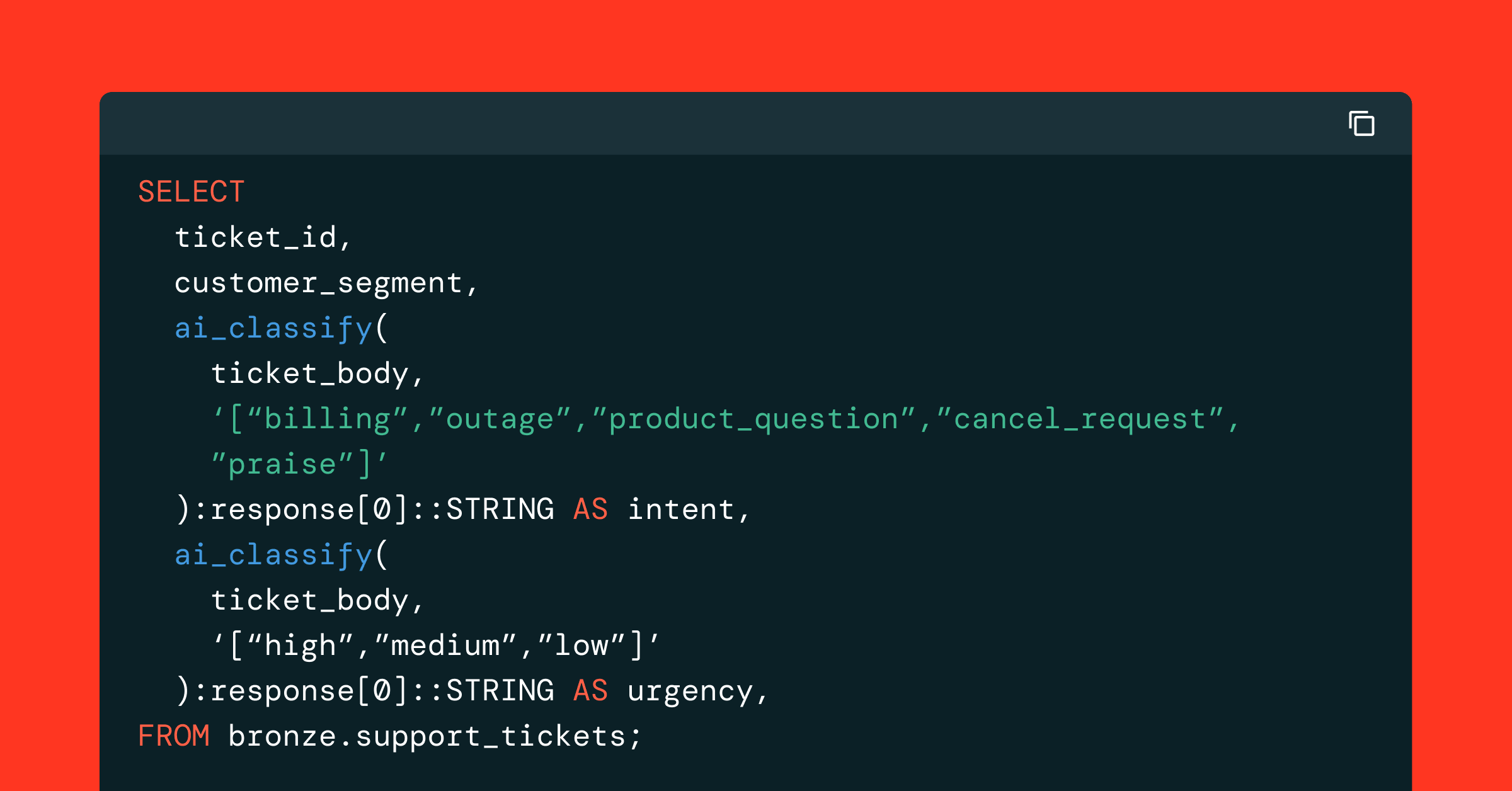
Databricks has launched AI Functions that integrate artificial intelligence capabilities directly into SQL queries within the data warehouse. This eliminates the need to export unstructured data—such as PDFs, images, or text—for external processing, reducing latency, schema dependency, and governance risks. Analysts can now perform tasks like document parsing, sentiment analysis, and classification without relying on separate services or custom pipelines. The functions operate under the existing Unity Catalog governance framework, maintaining data lineage and security standards.
The AI Functions include ai_parse_document for converting raw files into structured text, ai_extract for pulling specific data points from documents, and ai_classify for categorizing free-text feedback into predefined labels. These tools streamline workflows by collapsing multiple manual steps—such as OCR, LLM calls, and JSON parsing—into a single SQL query. For example, invoices stored in a Databricks volume can be parsed and their key fields extracted automatically, with results stored directly in a structured table. This approach reduces fragility and maintenance overhead compared to traditional custom solutions.
Additional functions like ai_translate and ai_query expand functionality further. ai_translate normalizes multilingual data into a single language within the query layer, preventing data silos and enabling global analysis. ai_query allows users to send prompts to Databricks-hosted foundation models, generating tailored outputs such as draft emails for customer renewals. These functions support operational efficiency by automating tasks like routing support tickets based on urgency or extracting deal stages from sales call transcripts, making qualitative data actionable for BI tools.
The integration of AI Functions into SQL queries represents a shift in how organizations handle AI workloads. By embedding AI directly into the data warehouse, Databricks eliminates the need for separate AI environments, reducing costs and complexity. Existing SQL ETL pipelines can incorporate AI steps without additional infrastructure, and Python scripts previously used for data translation or scoring can be replaced with single-line SQL commands. The company provides sample data and step-by-step guides to help users test the functions on their own datasets.