Running open-Jev in SQL on Databricks
Databricks enables running open-weight decision models like SemIf-OpenJev directly on governed data via SQL and serverless GPUs, simplifying enterprise applications.
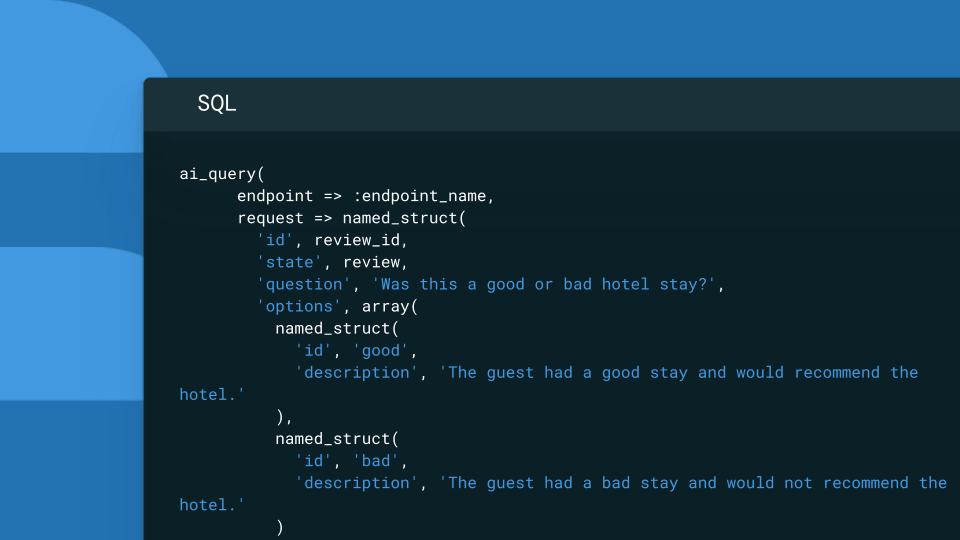
Databricks has introduced support for running open-weight decision models such as SemIf-OpenJev directly on governed data using serverless GPUs and the ai_query function. These models, including System One variants like Jev, generate calibrated decisions from predefined options and are optimized for speed and cost efficiency. By integrating them into Databricks, users can apply structured decisions at scale across large datasets without managing GPU infrastructure.
The integration allows models to be accessed directly from SQL consoles or production jobs in Lakeflow via ai_query, eliminating the need for custom API setups. Databricks AI Runtime provides serverless GPU compute, enabling on-demand processing for tasks like classifying hotel reviews as good or bad. The workflow is packaged in an importable Databricks Notebook for immediate deployment.
Users can deploy the open source classifier behind a managed endpoint, which supports arbitrary custom model APIs rather than standard chat-completions interfaces. This enables sending structured requests directly from SQL, returning classification results and option probabilities as columns in the dataset. The approach simplifies experimentation with decision models while maintaining governance over data.
The announcement highlights the rapid evolution of open source decision models and their practical applications in enterprise contexts. Databricks provides a ready-to-use notebook to test the pattern on existing data, encouraging users to adapt the workflow to their specific decision criteria and datasets.