Why A Frontier Data Agent Outperforms General Coding Agents in Quality and Cost
Databricks' Genie Code outperformed three leading coding agents in both accuracy and cost on 401 real-world tasks, achieving nearly half the expense per task while maintaining higher precision.
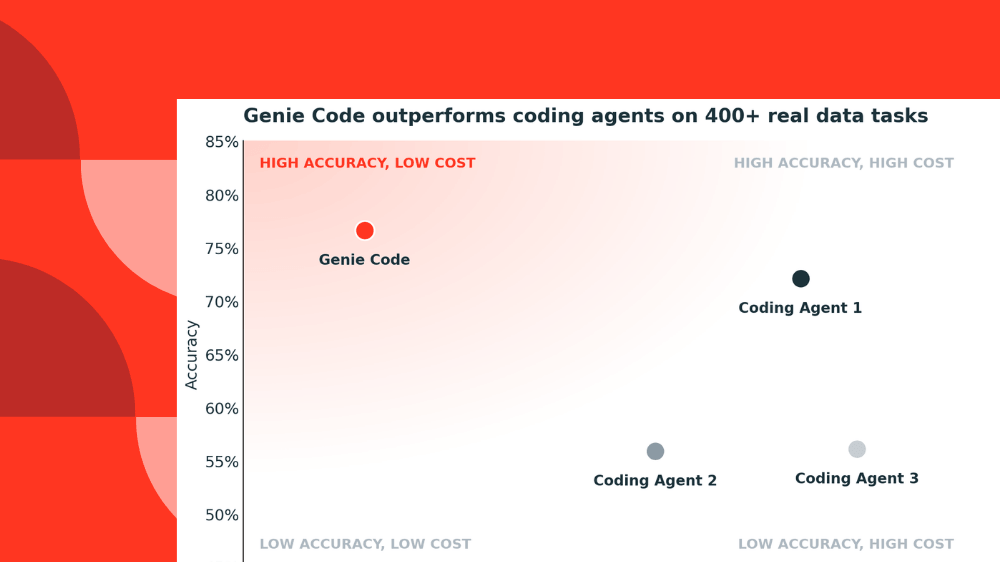
Databricks evaluated its Genie Code agent against three widely used coding agents from major AI labs on 401 real internal tasks. Unlike general coding agents, Genie Code demonstrated both higher accuracy and lower cost, challenging the assumption that better answers require more computational resources. The evaluation spanned discovery tasks, code debugging, and precise data lookups, with each agent given a 20-minute time limit per task. Genie Code achieved the highest accuracy while incurring roughly half the cost per task compared to its closest competitor.
The benchmark revealed that general coding agents struggled with tasks requiring asset discovery in dynamic workspaces, often timing out due to inefficient exploration. Genie Code addressed this by leveraging semantic search over catalogs, persistent memory of data assets, and deep enterprise context understanding. In one example, Genie Code completed a task in five tool calls by locating the correct table via semantic search, while general agents failed to recover from prolonged exploration. The median task cost for Genie Code was $0.34, with only 4% of tasks exceeding $2, compared to 33–40% for other agents.
Cost disparities stemmed from inefficiencies in data discovery, where general agents performed uncapped, resource-intensive queries. Genie Code averaged 8.3 tool calls per task—fewer than any competitor—due to its workspace context awareness. The evaluation graded responses on correctness and usefulness, with timeouts counting as failures. All agents used frontier-level models, ensuring variations in cost reflected operational efficiency rather than model capability.
The findings suggest that frontier data agents like Genie Code are better suited for dynamic, ambiguous environments than general coding agents. Databricks plans to expand evaluations based on real-world tasks, emphasizing that generic leaderboards may not reflect practical user experiences. The company attributes Genie Code’s advantages to its specialized design for data-centric workflows, where context retention and semantic understanding reduce redundant exploration.