Understanding the AI economy
Google launches ATLAS, a large-scale study tracking AI adoption across 150 countries and 800 occupations, revealing how workers use AI tools in daily tasks.
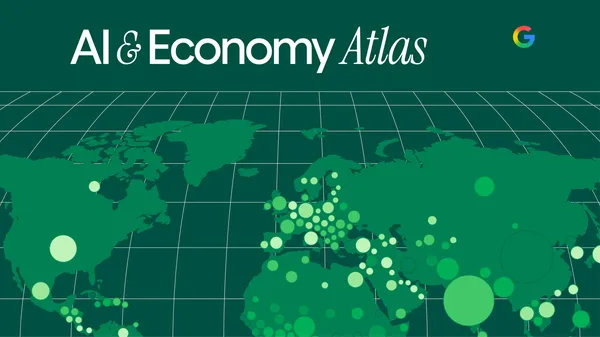
Google has introduced ATLAS, a study examining real-world AI usage through 15 million de-identified interactions from over 1 billion monthly users of its AI products, including the Gemini App and API. The research spans 150 countries, 140 languages, and 800 occupations, offering insights into how AI assists with tasks rather than replacing jobs entirely. Findings suggest AI tools are primarily used to enhance productivity in workplaces ranging from offices to repair shops.
The ATLAS v1.0 report highlights AI’s evolving capabilities and the need for structured observation tools to assess its economic impact. Google DeepMind’s OCTO technology organizes unstructured text data from LLM conversations into structured insights, enabling researchers to analyze trends across diverse user interactions. The study emphasizes the importance of empirical evidence in shaping AI policies and economic strategies.
Privacy protections are central to ATLAS, with multiple layers removing personally identifiable information and preventing data linkage to individual user logs. Aggregated summaries ensure insights reflect broader usage patterns without compromising confidentiality. The report acknowledges contributions from economists Dame Diane Coyle and Dr. David Autor, underscoring the study’s academic rigor.
ATLAS represents the first phase of a long-term project, with future iterations expected to expand scope and depth. While the study covers significant ground, it does not capture all economically relevant AI uses, such as Google Workspace or enterprise platforms like Gemini for Google Cloud. Google’s AI & Economy Research Program will continue collaborating with academics to refine methodologies and address gaps in understanding AI’s broader economic transformation.