Hyundai Motor Group Executive Chair Euisun Chung Charts Mid-to-Long-Term Growth Strategy in Brazil
Hyundai Motor Group Executive Chair Euisun Chung outlined Brazil’s mid-to-long-term growth strategy during a visit to the Piracicaba plant, emphasizing local production, hydrogen energy, and market-specific models.
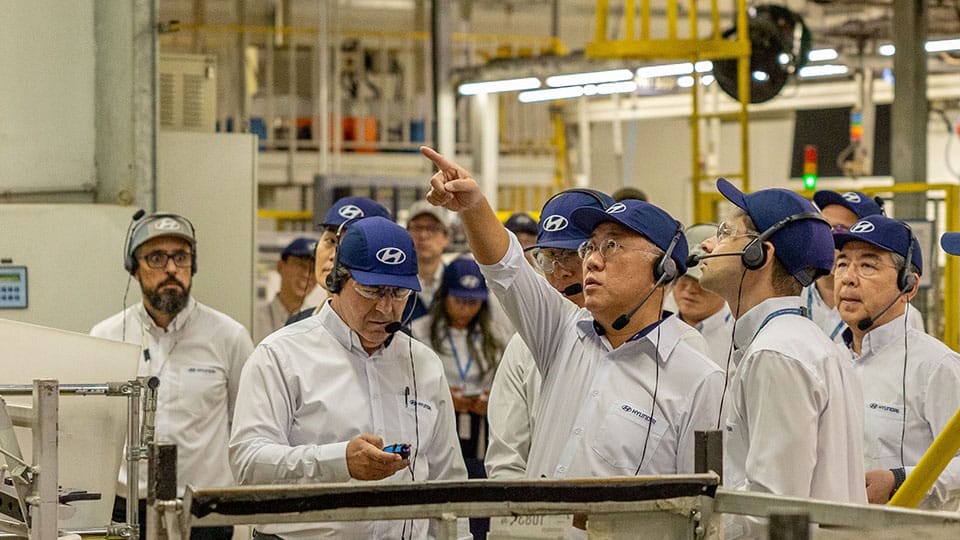
Hyundai Motor Group Executive Chair Euisun Chung visited Hyundai’s Piracicaba plant in Brazil on July 30, 2026, to outline the Group’s mid-to-long-term growth strategy for the country. The plan focuses on expanding local production, exploring hydrogen energy opportunities, and strengthening competitiveness in Brazil’s automotive market, where fuel-flexible vehicles dominate demand. The Piracicaba plant, operational since 2012, produces 200,000 vehicles annually across three models—HB20, CRETA, and i20—with a cumulative output of 2.5 million units by March 2026.
Executive Chair Chung reviewed production operations and inspected the i20 and CRETA SUV during the visit. The i20, launched in June 2026, is positioned as a core model in the B-segment, which accounts for 23 percent of Brazil’s automotive market. Equipped with a fuel-flexible powertrain optimized for local conditions, the i20 offers SUV-like space, advanced technology, and safety features. Hyundai aims to establish the i20 as a bestseller through product and quality competitiveness, supported by multi-sector partnerships in travel, retail, and entertainment.
Hyundai Motor plans to strengthen sales of the CRETA while introducing new SUV models by 2030. The company is also exploring local production of small electric vehicles and accelerating development of fuel-flexible hybrid powertrains tailored for Brazil’s ethanol-gasoline fuel ecosystem. These initiatives align with Brazil’s National Hydrogen Program (PNH2), which aims to develop a low-carbon hydrogen industry and position the country as a global producer and exporter.
Hyundai Motor reported first-half 2026 sales of 96,723 units in Brazil, a 12.1 percent increase from the same period in 2025. The HB20 and CRETA models have driven growth, with cumulative sales of 1.88 million and 570,000 units, respectively. Hyundai aims for total 2026 sales of 204,000 units, supported by expanded R&D capabilities and industry-academy partnerships in hydrogen research with institutions like the University of São Paulo.