NASA’s SpaceX 35th Commercial Resupply Mission Overview
NASA and SpaceX are set to launch a resupply mission to the International Space Station on October 13, carrying over 6,300 pounds of cargo and scientific experiments, including studies on artificial retinas, heart tissue, and glass formation.
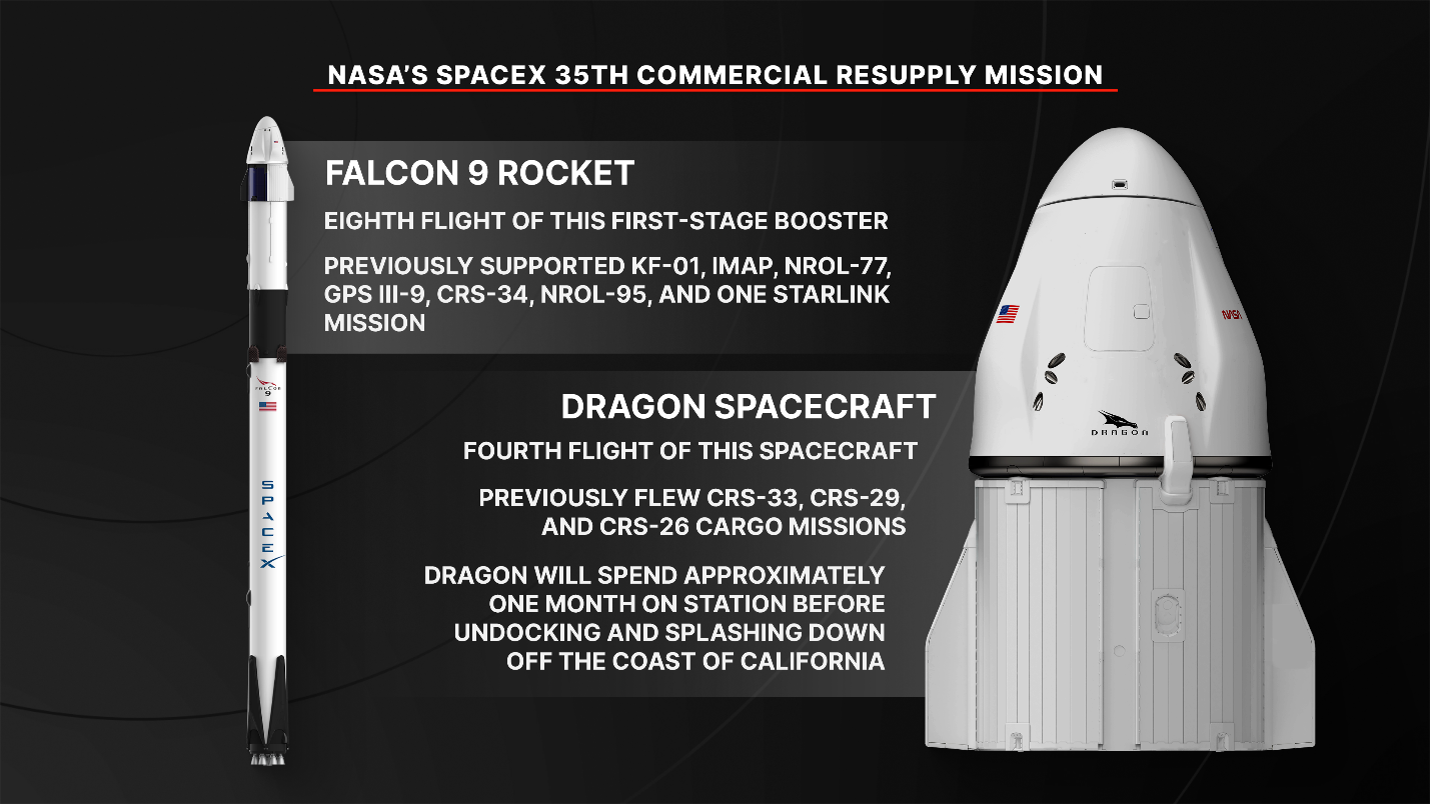
NASA and SpaceX have scheduled the launch of the SpaceX Dragon spacecraft for no earlier than October 13 aboard a Falcon 9 rocket from Cape Canaveral Space Force Station in Florida. The mission will transport more than 6,300 pounds of supplies, equipment, and scientific investigations to the International Space Station. The Dragon spacecraft will autonomously dock to the space-facing port of the station’s Harmony module upon arrival.
The International Space Station has hosted research from scientists in over 110 countries for more than 25 years, enabling thousands of microgravity experiments. These studies support long-duration missions to the Moon under the Artemis program and to Mars, while also delivering benefits to humanity on Earth. The Dragon spacecraft will deliver new science experiments alongside crew supplies and maintenance hardware.
Among the experiments is LambdaVision-1, which tests manufacturing artificial eye retinas in microgravity by building layers one at a time. Reduced settling in microgravity may create more uniform layers, potentially improving implant performance for patients with retinal diseases. The Stellar Spheroids experiment will study how microgravity affects the growth of 3D human heart tissue models and the formation of vascular networks.
The Dragon spacecraft will remain docked to the space station for about a month before splashing down in the Pacific Ocean in mid-November. It will return critical science samples, a failed Canadarm2 joint for analysis, a spacesuit, and components from the urine and water processor assemblies. NASA astronauts Anil Menon and Jessica Watkins will monitor the spacecraft’s arrival.