Tossing Fireworks from Cloud to Cloud
Astronauts aboard the International Space Station captured a striking nighttime view over the South China Sea, highlighting city lights, fishing fleets, and lightning storms in vivid detail.
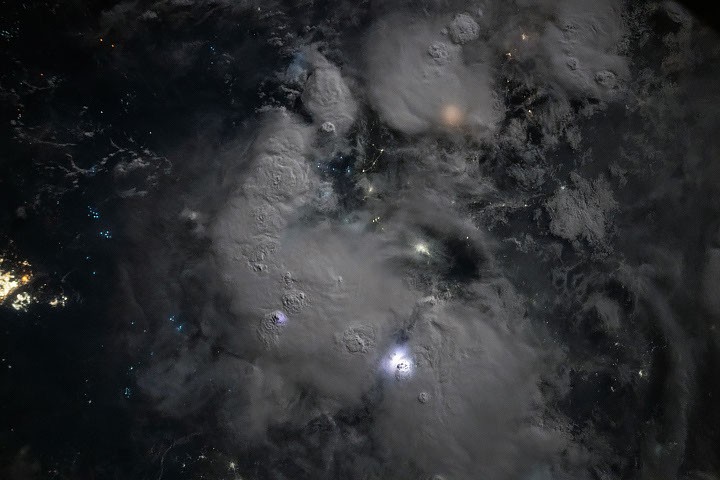
Astronaut Donald Pettit described Earth’s nighttime lights from the International Space Station as resembling "tendrils outlined with the glimmer of a Broadway marquee," while Sally Ride noted lightning as particularly spectacular when viewed from above. The space station’s orbit offers a unique perspective, turning storms into "transcontinental brigades tossing fireworks from cloud to cloud."
On October 28, 2026, at 14:20 UTC, an astronaut photographed a scene over the South China Sea near Borneo, capturing overshooting tops from thunderstorms illuminated by lightning flashes. The image also revealed the bright lights of Singapore, a city-state of 6.2 million people, and the glow of fishing boats likely attracting squid or small fish with their lights.
The photograph, taken with a Nikon Z9 camera, showed two distinct lightning-illuminated storm cells rising above the anvil of thunderstorms, indicating strong updrafts and intense weather. Offshore to the northwest, scattered orange points were identified as likely gas flares, adding to the scene’s complexity.
NASA scientists estimate that 2,000 thunderstorms occur globally at any moment, producing nearly 60 flashes per second—about 5 million flashes daily. The image, labeled ISS075-E-250951, was processed by the ISS Crew Earth Observations Facility and is available through NASA’s Gateway to Astronaut Photography of Earth.