Fuel Every Agent and App With Data That Keeps Pace
Snowflake unveils new tools to streamline AI agent and application development by automating data pipelines, improving Spark workloads, and enabling declarative workflows for faster, more reliable data processing.
Many organizations struggle to scale AI agents and applications because their data pipelines fail to keep pace with real-time demands, leading to outdated or inconsistent outputs that erode trust. Snowflake’s latest announcement introduces tools to address this gap by automating data ingestion, transformation, and monitoring, ensuring agents and apps operate on current, accurate information. The focus is on reducing manual engineering work while maintaining reliability, allowing teams to focus on innovation rather than pipeline maintenance.
New capabilities include Adaptive Compute for automatic workload optimization, Snowpark Connect for running existing Spark code directly on Snowflake without external clusters, and Dynamic Tables for declarative SQL pipelines with incremental logic. These features aim to simplify infrastructure management, reduce tuning efforts, and enable teams to process only necessary data changes, improving efficiency and performance for both real-time and batch workloads.
For teams using Apache Iceberg, Snowflake expands support with incremental reads, Time Travel, and tags for rollback and checkpointing, alongside new Iceberg v3 compatibility and row lineage for auditing. A Spark Monitoring UI and Code Bundles further enhance debugging and job submission, while a migration skill converts existing PySpark, Scala, and Java notebooks to run natively on Snowflake, lowering adoption barriers.
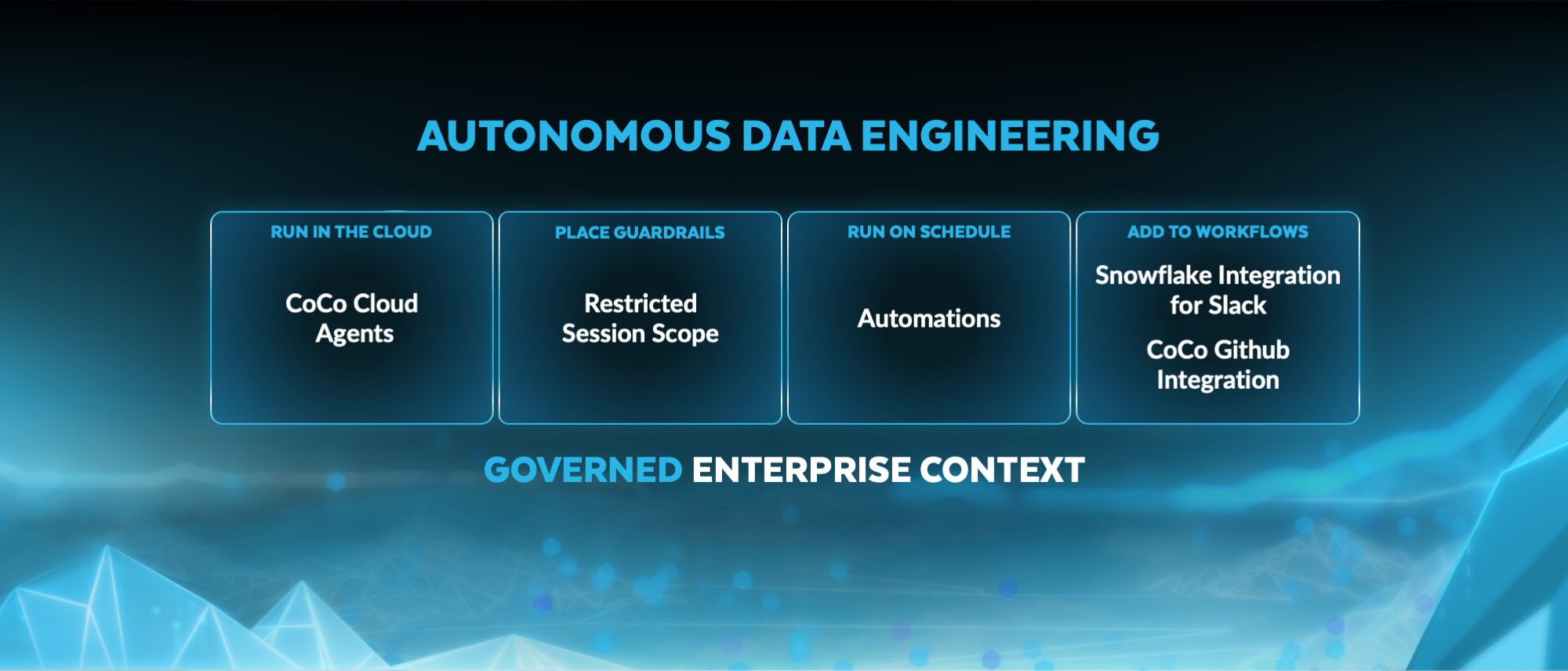
The announcement also introduces Cloud Agents and Coding Agents to automate routine data engineering tasks, such as pipeline health checks and job failure investigations, with isolated, secure environments managed by Snowflake. Declarative workflows via dbt Projects and DCM Projects reduce manual testing and infrastructure management, while Dynamic Tables Insights and automated Snowpipe setup provide actionable optimization recommendations. These tools collectively aim to accelerate AI development by embedding governance, testing, and automation directly into the data platform.