Agents are users, so your software needs evals
Vercel argues agents now act as software users, requiring evaluation tools to measure task completion accuracy across repeated tests rather than single manual checks.
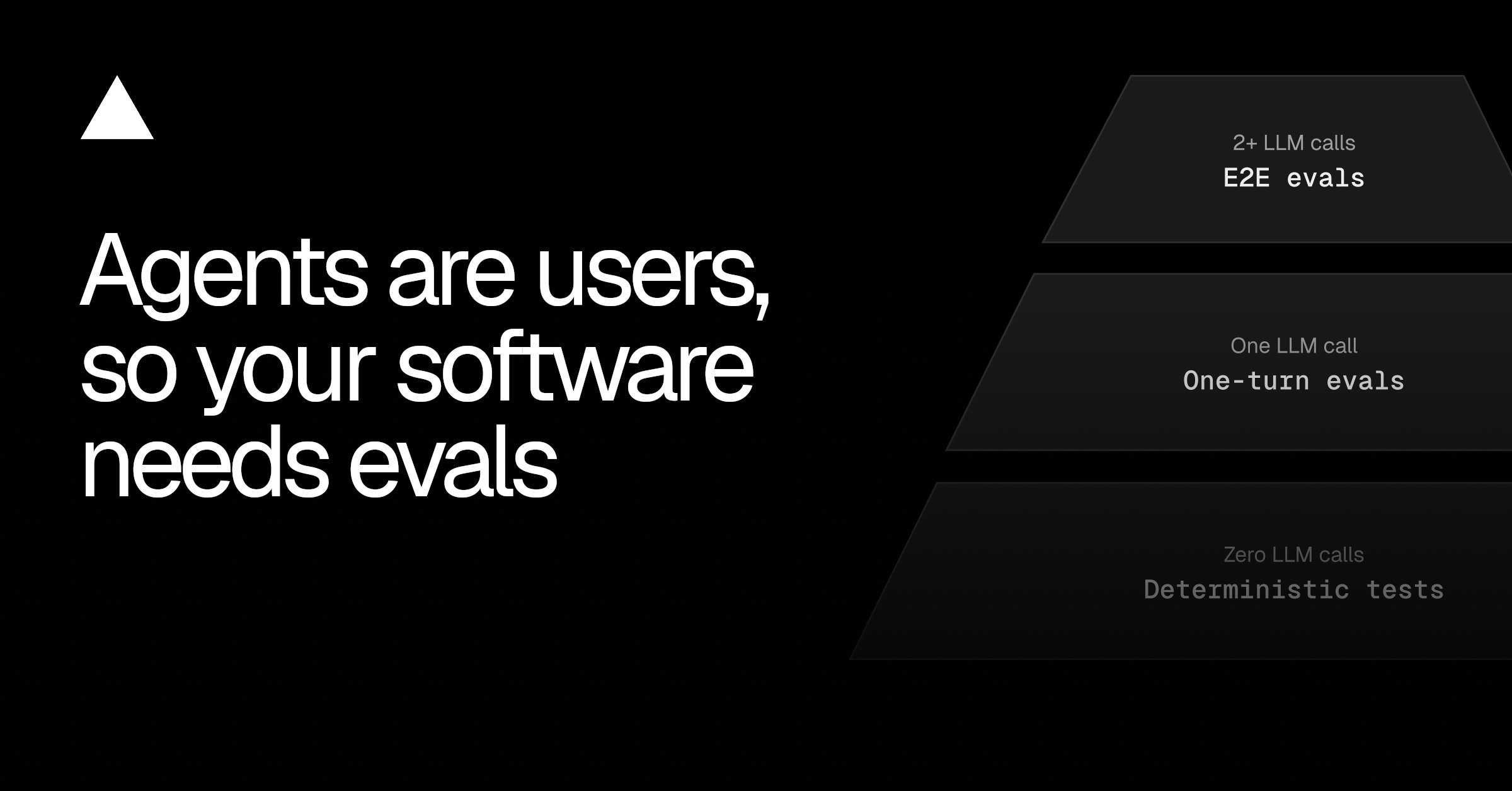
Agents function as users, performing tasks on behalf of people, which means software must be evaluated differently than traditional applications. Whether building the agent or the tools it uses, developers need a way to measure how effectively tasks are completed. While agents may not engage with marketing materials, they follow the same user journey—discovery, selection, access, and success—requiring evaluation at each stage. The focus here is on the final stage: success, or whether the agent fulfills the user’s request correctly.
Measuring success is challenging because agents can appear to complete a task without meeting the user’s actual requirements. For example, an agent might place an order for a hot latte when the user requested an iced one, yet logs may still show a successful transaction. Due to variability in LLM outputs, a single manual test cannot reliably determine if a fix improves performance. Instead, developers must repeatedly run the same tasks and grade outcomes to assess effectiveness.
Agentic software tests are categorized by the number of LLM calls they require: deterministic tests (0 calls), one-turn evals (1 call), and end-to-end (E2E) evals (2+ calls across a task). This structure mirrors the traditional software test pyramid, where cheaper and faster tests form the foundation. For measuring success, E2E evals are necessary to evaluate the entire sequence of steps, such as searching for cafes, filtering options, and placing an order.
To demonstrate, the post uses a hypothetical coffee-ordering API, sfbeans, to illustrate how E2E evals work. Tasks include verifying that the agent selects the correct commands, generates accurate arguments, and places an order that meets all user criteria. The evaluation framework, Harbor, runs agents in containers, records their actions, and checks results to ensure the final outcome aligns with the user’s request.