ATLAS and CMS narrow in on double-Higgs production – Home
ATLAS and CMS experiments at CERN’s LHC have set new constraints on the rare double-Higgs boson production rate, advancing understanding of the Higgs boson’s self-interaction and the stability of the universe’s vacuum.
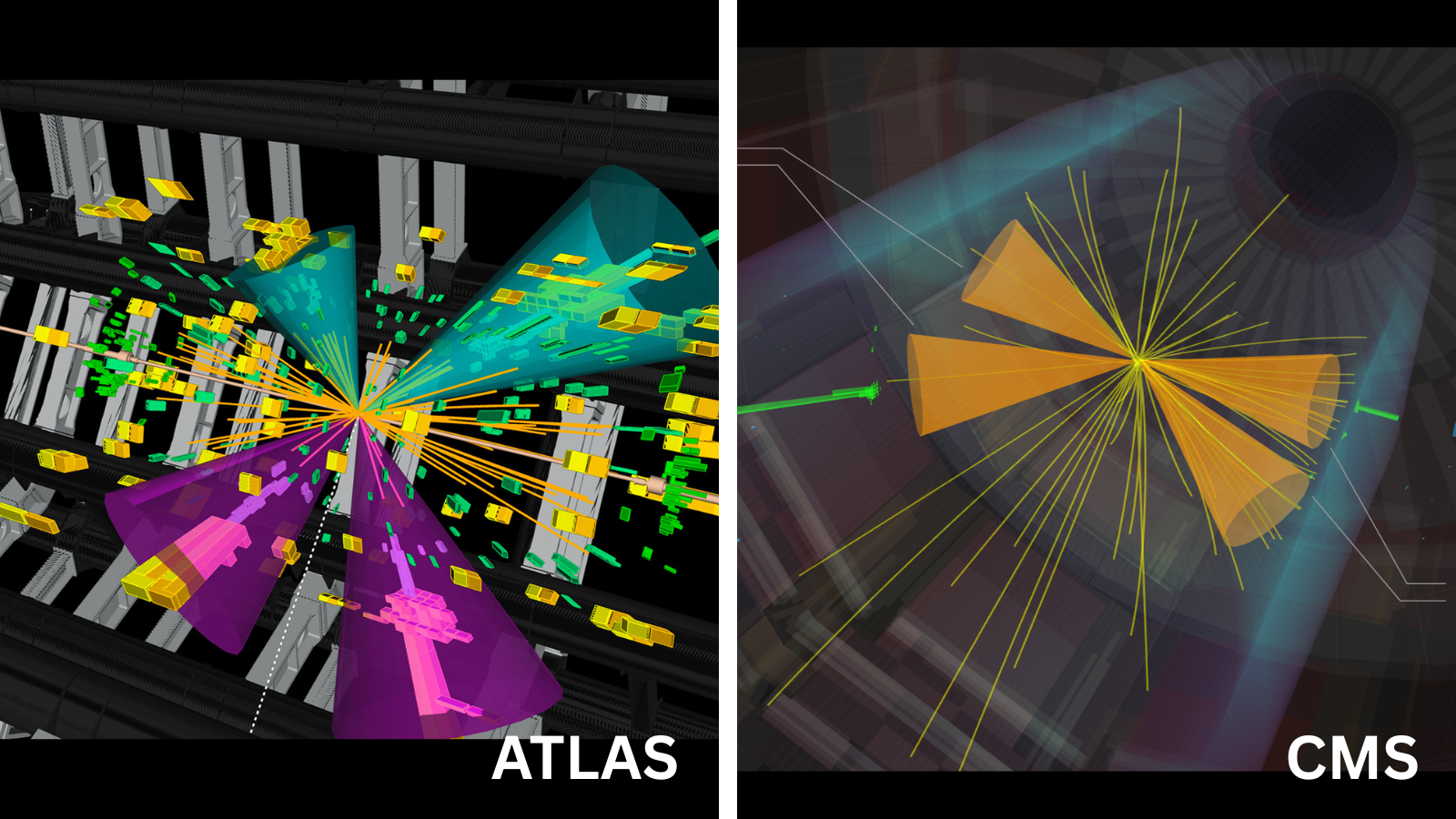
The ATLAS and CMS Collaborations at the Large Hadron Collider (LHC) have presented new constraints on the production rate of double-Higgs bosons, a process that remains extremely rare. Based on Standard Model predictions, only about one pair of Higgs bosons is expected for every 1,500 single Higgs bosons produced in collisions. Researchers are investigating how the Higgs boson interacts with itself, a key test of the Standard Model and the stability of the universe’s vacuum.
To detect double-Higgs production, scientists analyzed a specific decay channel where one Higgs boson decays into a bottom quark and antiquark, and the other into a tau particle and its antiparticle. By combining data from previous LHC runs with the latest third run and using advanced machine-learning techniques, the collaborations conducted a more sensitive search for the process, focusing on decays into two bottom quarks and two tau particles.
While the analysis identified more events consistent with double-Higgs production, the signal remains insufficient for a definitive observation. ATLAS reported a 2.6 standard-deviation excess above background expectations, suggesting possible production of Higgs pairs, though not yet conclusive. CMS, in parallel, excluded production rates exceeding four times the Standard Model prediction.
The collaborations also set new limits on the Higgs self-coupling parameter, which governs how strongly the Higgs boson interacts with itself. These results mark progress toward future analyses combining full datasets from LHC Runs 2 and 3, with the High-Luminosity LHC expected to increase collision data by a factor of six, bringing scientists closer to observing double-Higgs production.