Accelerator Report: Beyond the LHC – CERN’s Beams Keep Science Moving – Home
CERN’s accelerator complex remains active during the LHC’s Long Shutdown 3, delivering beams for ongoing experiments while preparing future upgrades, including tests for the SHiP experiment and material studies at HiRadMat.
The Large Hadron Collider (LHC) is in Long Shutdown 3, but CERN’s injector chain continues operating, supplying proton beams to experiments studying antimatter, nuclear reactions, and astroparticle physics. The East and North Area experiments, the ELENA antiproton community, and the n_TOF facility all receive beams, demonstrating the accelerator complex’s ongoing scientific contributions. The injectors also support material testing at the High Radiation to Materials facility (HiRadMat), where researchers study failure thresholds of components under intense beam exposure to improve future accelerator reliability.
This week marks HiRadMat’s final run of the year, featuring an experiment to systematically assess materials, including those never before used as beam monitors. By exposing these materials to high-intensity beam pulses from the Super Proton Synchrotron (SPS), scientists aim to enhance the robustness of beam monitoring systems. The findings will inform the design and operation of current and future high-intensity accelerators, addressing a critical gap in existing research.
A machine development programme is underway to optimize accelerator processes, including preparations for the future SPS Beam Dump Facility (BDF) for the Search for Hidden Particles (SHiP) experiment. SHiP aims to detect feebly interacting, long-lived particles that could explain dark matter and other fundamental physics questions. Recent tests involved prototypes of the BDF production target, successfully cooling a tungsten target with gaseous helium under 400 GeV/c proton beam impact.
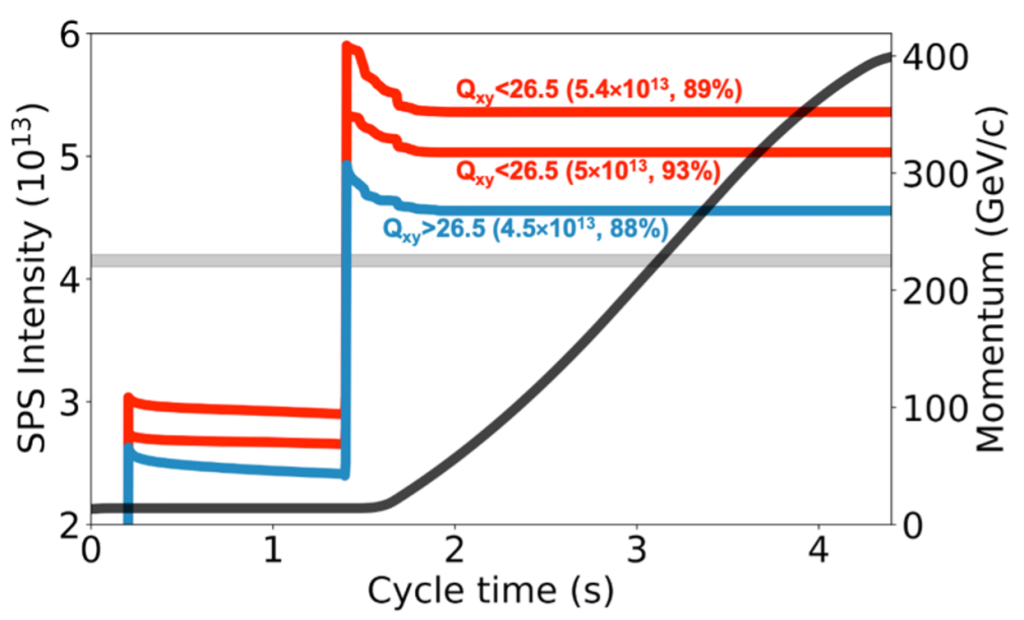
The SPS machine development programme also explored increasing beam intensity for SHiP, achieving a record 5.4 x 10^13 protons per cycle at 400 GeV/c with a 90% transmission rate. Additionally, new crystal technology was tested to reduce beam loss on extraction septa by over 75%, improving future high-intensity operations. The North Area’s ion-physics programme is set to begin next week, continuing CERN’s role in advancing fundamental research despite the LHC’s shutdown.