HiLumi LHC: new magnets reach full power – Home
CERN’s new quadrupole magnets for the High-Luminosity LHC reached their full operating current of 16,230 amperes on 8 July, validating key technologies ahead of the 2030 upgrade.
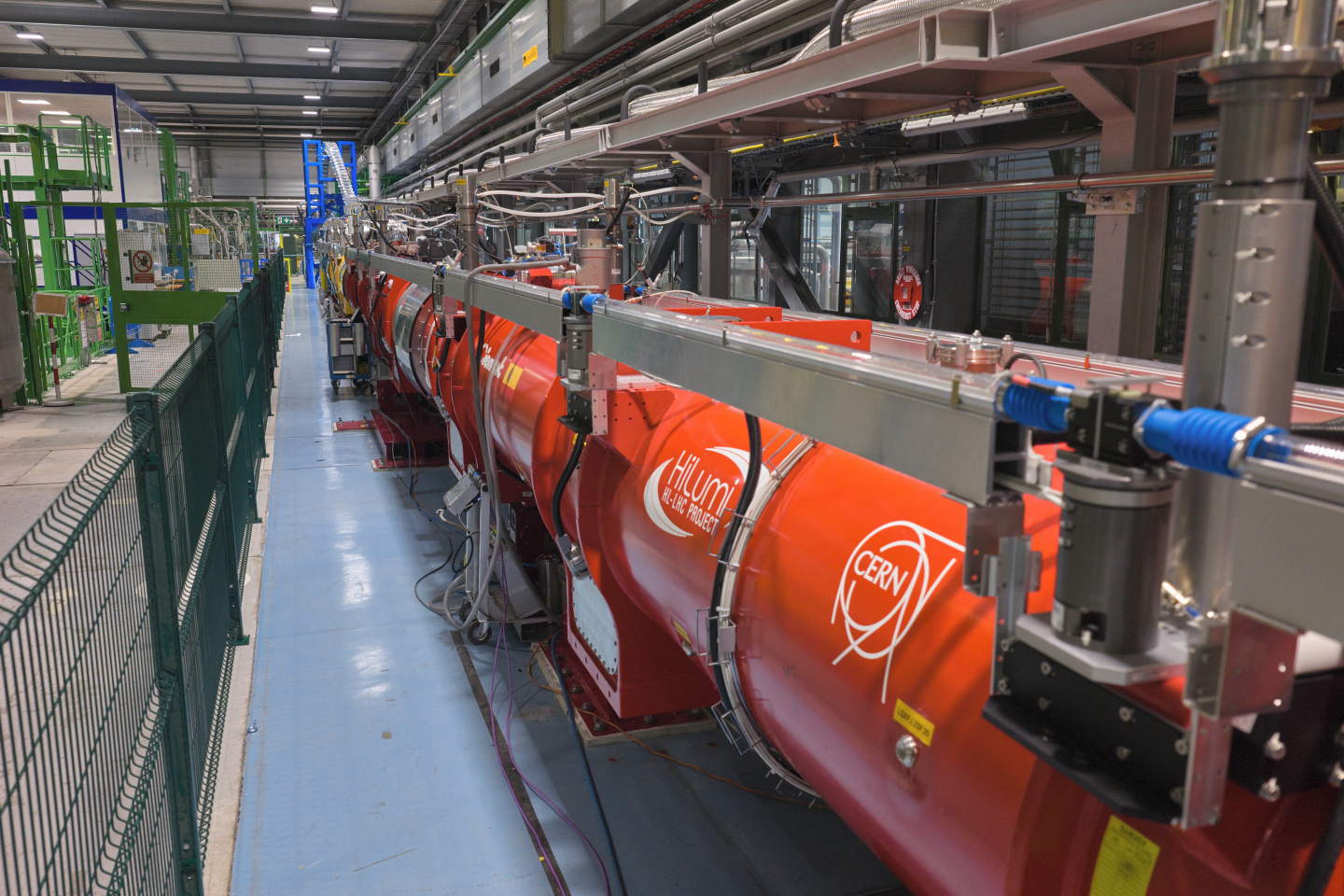
The IT String test facility at CERN achieved a milestone on 8 July when its new quadrupole magnets, designed for the High-Luminosity LHC, reached their nominal operating current of 16,230 amperes without quenching. These magnets, featuring a 150-millimetre aperture and niobium–tin superconducting coils, will focus particle beams more tightly to increase collision rates. The successful test confirms the magnets’ ability to retain their trained performance, reducing future commissioning time and operational delays. Susana Izquierdo Bermudez, head of CERN’s Large Magnet Facility, highlighted the importance of this achievement for the project’s timeline.
The test campaign also validated the performance of the separation dipole magnet, which steers beams apart after collisions, and the corrector magnet circuits, both reaching their target currents with minimal training quenches. All 17 electrical circuits in the IT String were powered to operating levels, demonstrating the system’s readiness. The magnets are cooled to 1.9 K (-271 °C) and protected by systems that safely dissipated up to 38 megajoules of stored energy during the tests. Samer Yammine, responsible for IT String operations, noted the completion of hardware commissioning and the start of data analysis to refine future operations.
Engineers are now analyzing data from the test campaign to understand interactions between subsystems, including superconducting magnets, cryogenics, vacuum, and controls. The results will inform the commissioning and operation of the High-Luminosity LHC, scheduled to begin in 2030. Additional tests are planned to investigate superconducting circuits, machine cycles, and alignment under conditions closer to the future accelerator’s environment. Marta Bajko, head of the IT String facility, emphasized the focus on validating commissioning procedures and reproducibility in the next operational phase.
The IT String will undergo a warm-up and cooldown cycle before a second test campaign in September, which aims to validate commissioning procedures and analysis tools. This phase will test the integrated system under conditions mimicking those of the High-Luminosity LHC. The facility’s performance during these tests will provide critical insights to optimize the upgrade’s future operation and ensure the magnets meet the project’s stringent requirements.