First major structure of the future CMS tracker arrives at CERN – Home
The first major component of the future CMS tracker, the Tracker Barrel 2S wheel, has arrived at CERN for the High-Luminosity LHC upgrade. The 2.3-metre structure, built in France, will support over 4,000 silicon sensor modules starting in 2027.
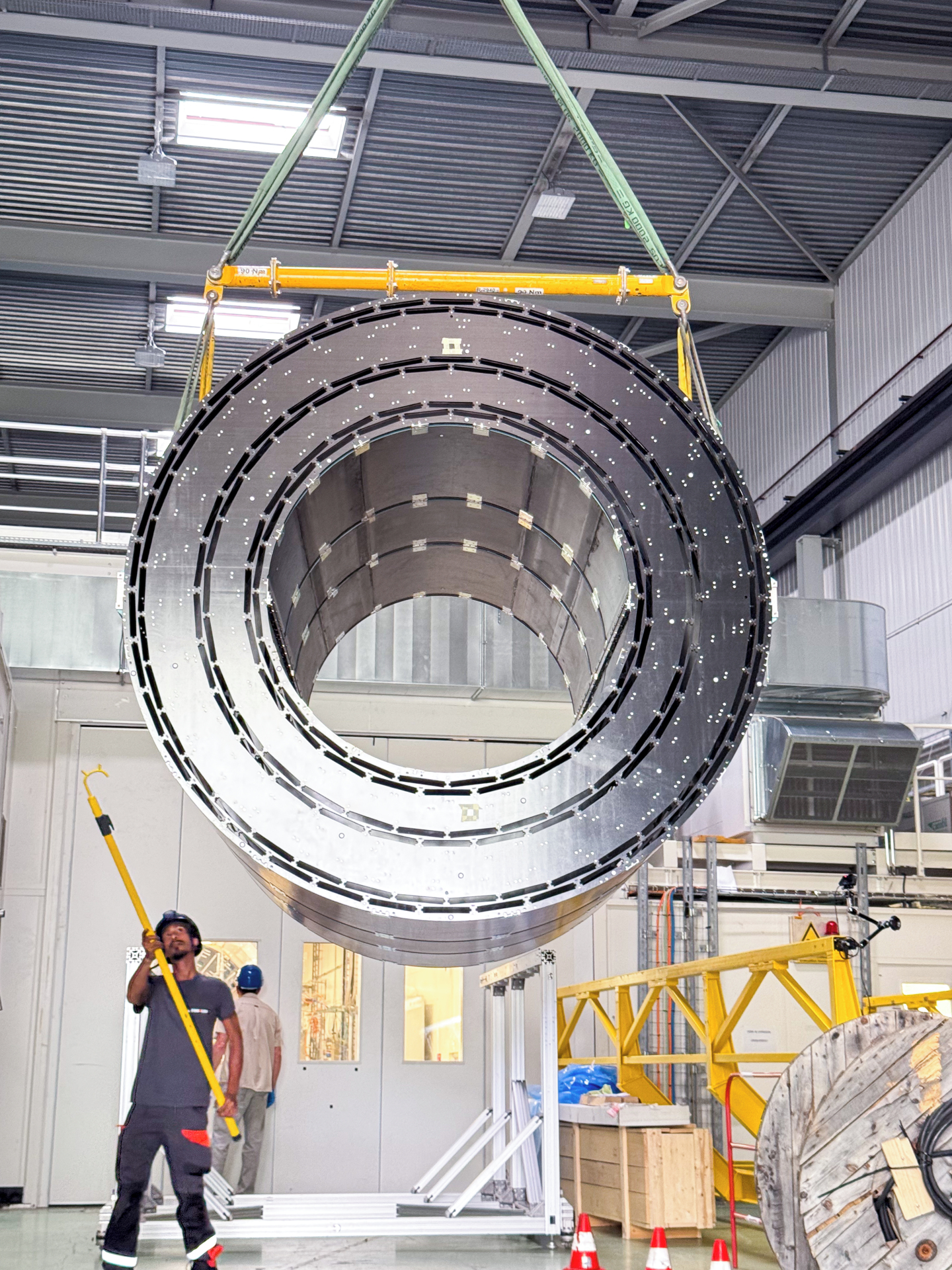
The Tracker Barrel 2S (TB2S) wheel, a 2.3-metre-long mechanical structure, has arrived at CERN as part of preparations for the High-Luminosity LHC (HiLumi LHC). Designed and assembled by teams at the IPHC (CNRS/University of Strasbourg) in France, the TB2S forms the outer framework of the CMS detector’s future tracker. Constructed from lightweight carbon-fibre composites, it balances high precision with the strength required to support hundreds of kilograms of detector components.
The project, launched in 2017, marks a critical step in upgrading the CMS tracker to handle the increased collision rates expected at the HiLumi LHC. The TB2S wheel was transported from Strasbourg to CERN in July using a specially designed container. Upon arrival, it will undergo further measurements before silicon modules are installed, with installation of over 4,000 2S-type silicon sensor modules planned to begin in 2027.
Each silicon sensor module consists of two silicon microstrip sensors separated by 1.8 mm, designed to enhance the detector’s precision. The TB2S wheel will serve as the backbone of the new CMS tracker, enabling the experiment to record the unprecedented data volume anticipated during the HiLumi LHC era. The structure’s integration is expected to significantly improve the detector’s performance.
The arrival of the TB2S wheel follows years of development and collaboration between CNRS, the University of Strasbourg, and CERN. The next phase involves integrating the silicon modules onto the structure, a process that will require meticulous assembly and testing. This upgrade is essential for maintaining the CMS detector’s capabilities amid the higher collision rates of the High-Luminosity LHC.