The July/August 2026 issue of the CERN Courier is out – Home
The July/August 2026 CERN Courier reviews the legacy of LEP, upgrades to NA64, and the open-source Xsuite framework, alongside Europe’s particle physics strategy update favoring the FCC-ee collider.
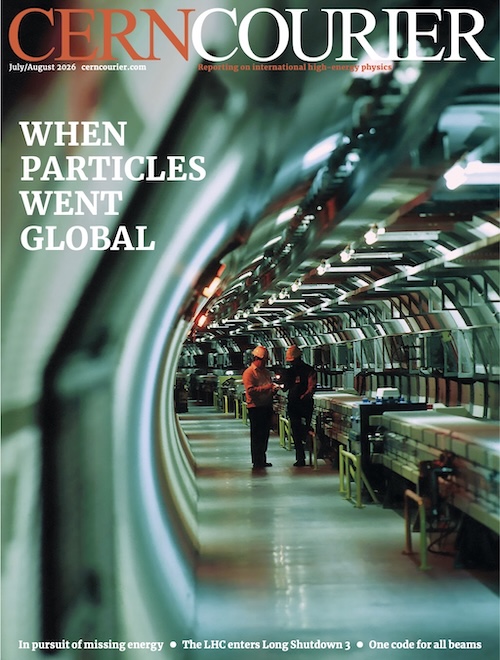
The Large Electron–Positron collider (LEP), launched in 1989 after eight years of approval, operated until 2000, pioneering global collaboration in particle physics. A November 2025 symposium at CERN reflected on its two-decade impact, while the Large Hadron Collider, built within LEP’s tunnel, concluded its final collisions in June 2026. The meeting underscored LEP’s role in establishing CERN as a hub for large-scale experimental science.
NA64, an experiment searching for dark sector particles via missing energy signatures, has operated for a decade by firing probes at targets. The collaboration now plans upgrades to handle higher beam intensities, aiming to expand its dataset by up to 100 times. These enhancements will improve sensitivity to rare interactions, potentially uncovering new physics beyond the Standard Model.
Xsuite, an open-source framework, consolidates beam-simulation tools previously scattered across the field. It now supports the design of future colliders, optimization of existing machines, and modeling of synchrotrons for medical applications such as cancer treatment. The tool exemplifies collaborative software development in accelerator science.
In May 2026, the CERN Council updated the European Strategy for Particle Physics, prioritizing an electron–positron collider, the FCC-ee, as the next flagship project. Council president Costas Fountas outlined prerequisites for a 2028 decision, including technical feasibility, funding alignment, and international partnerships. The strategy reaffirms Europe’s commitment to precision measurements in particle physics.