CMS explores subtle matter–antimatter difference using beauty mesons – Home
CMS Collaboration reports new high-precision test of matter–antimatter differences using beauty mesons, finding results consistent with the Standard Model.
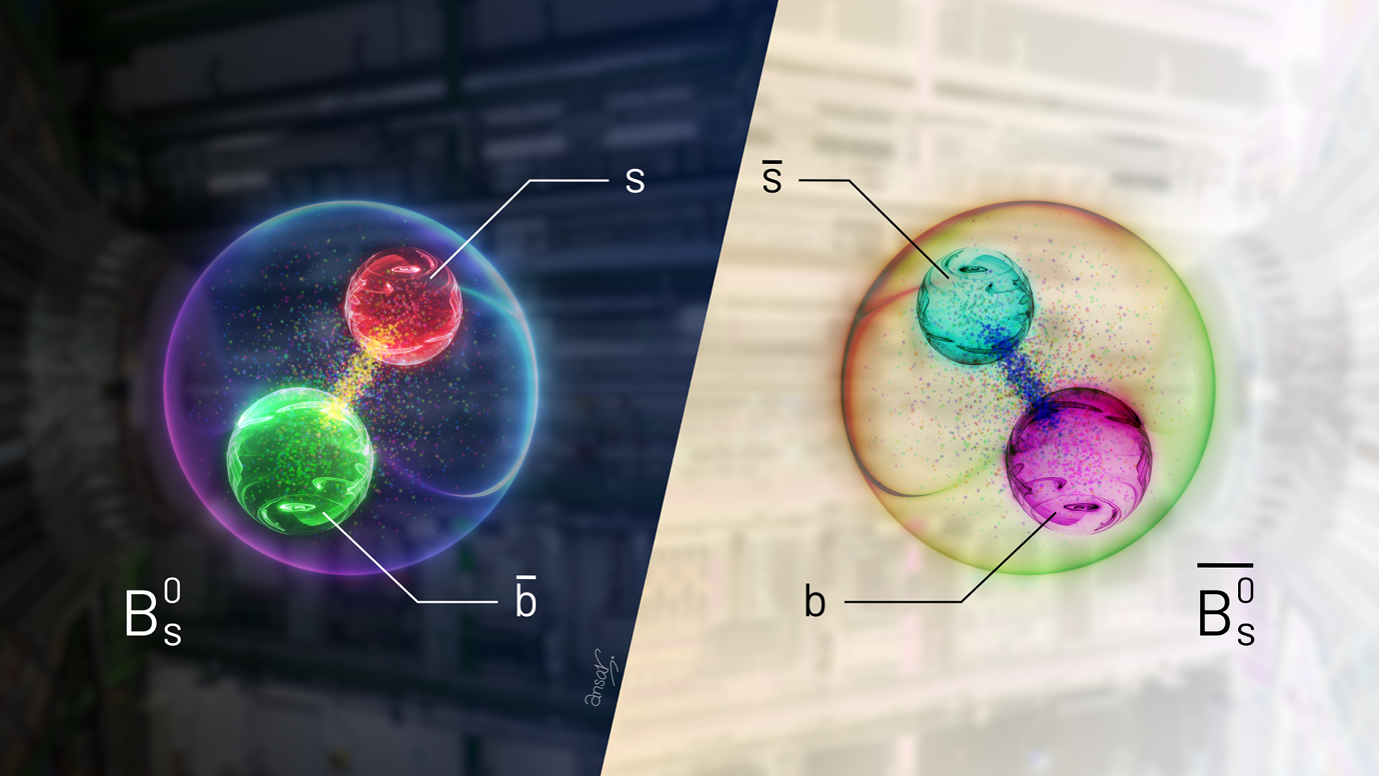
The CMS experiment has analysed the largest sample of beauty mesons to date, probing a subtle imbalance between matter and antimatter known as charge-parity (CP) violation. Neutral beauty mesons, which oscillate between particle and antiparticle states, were studied to measure tiny differences in their decay rates. The analysis used proton–proton collision data from 2022 to 2025, reconstructing decays of approximately 1.4 million B mesons and 16,000 Bs mesons. The findings align with Standard Model predictions, providing the most precise measurement yet of CP violation in Bs meson decays.
Researchers employed an artificial intelligence-based algorithm to identify the initial state of each meson before it decayed into a J/ψ meson and a neutral kaon. The algorithm integrated data from muons, electrons, jets, and nearby collision particles, improving identification accuracy compared to prior methods. This technological advance enabled the team to achieve unprecedented precision in reconstructing the meson’s origin. The improved methodology addresses a key challenge in distinguishing between matter and antimatter states during particle collisions.
The measurements confirm CP violation effects in line with the Standard Model, with the Bs meson decay analysis setting a new benchmark for precision. The complementary study of B meson decays further tests the same fundamental physics, reinforcing the consistency of the results. Together, these findings tighten constraints on potential contributions from unknown particles beyond the Standard Model. The work underscores the role of beauty mesons as sensitive probes of matter–antimatter asymmetries.
As the Large Hadron Collider enters its High-Luminosity phase, future datasets will allow even more precise CP violation measurements. These efforts aim to either confirm the Standard Model with greater certainty or reveal subtle deviations that could point to new physics. The ongoing experiments deepen understanding of why the universe is dominated by matter, addressing one of the most enduring questions in particle physics.