Contextual Policies in Omnigent: Using session state to better govern AI agents
Databricks’ Omnigent introduces contextual policies for AI agents, enabling session-aware governance through state tracking to dynamically enforce security, spending, and risk controls across tools like Claude Code and Codex.
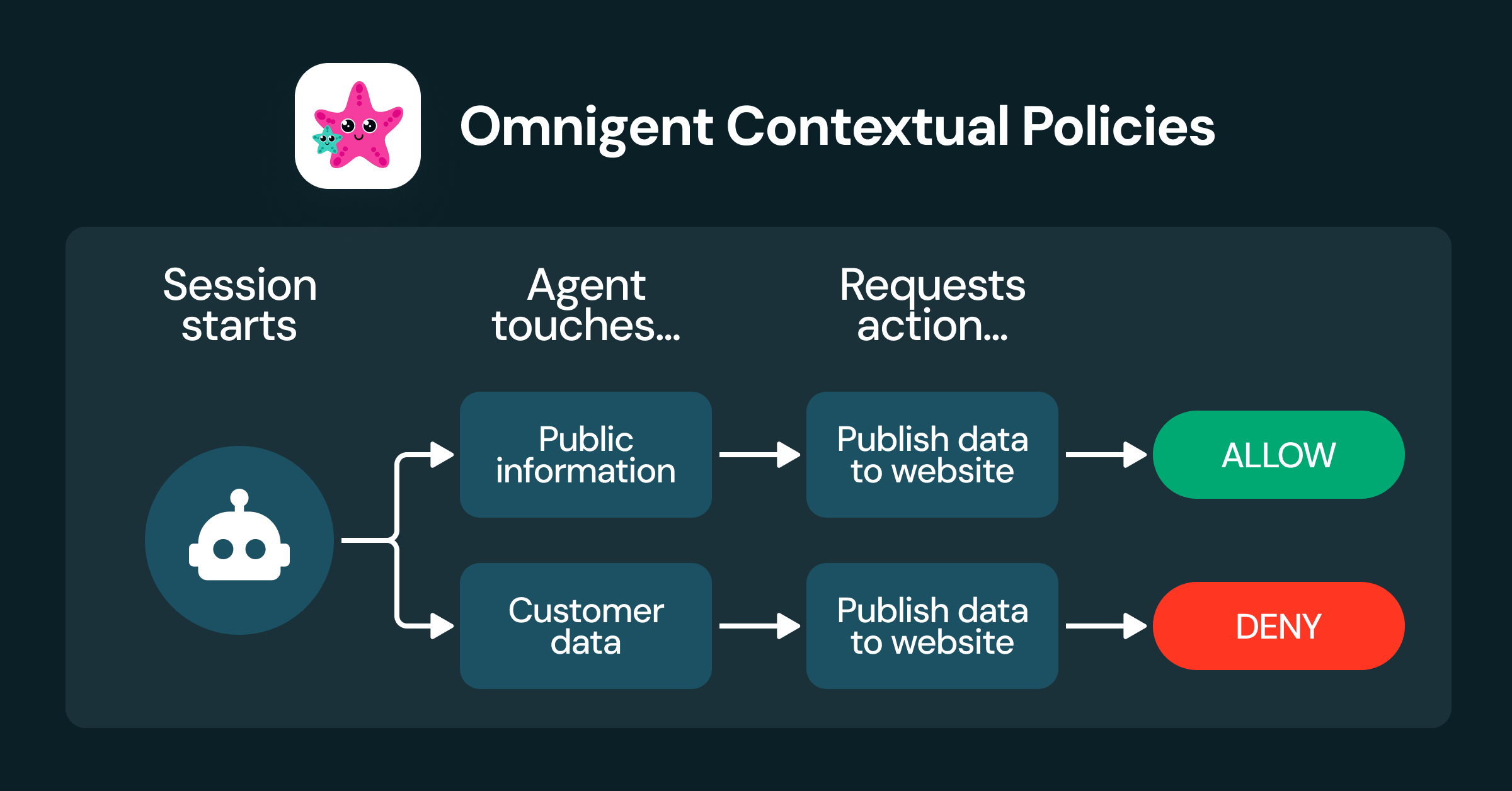
Omnigent, an open-source meta-harness for AI agents, now supports contextual policies that evaluate actions based on session history rather than isolated rules. These policies can track variables such as cumulative spending, document access, or risk levels to determine whether an agent’s next step should proceed. For example, a coding agent’s GitHub push may be permitted after editing a feature but blocked if it previously accessed untrusted content, addressing risks like prompt injection. The system allows per-session configurations, including spending caps or dynamic guardrails that tighten as risk accumulates, offering finer control than traditional agent frameworks.
The framework includes built-in policies for managing access to tools like Google Drive, where writes are restricted to documents created during the session unless explicitly marked confidential. A risk-scoring policy tracks cumulative session risk, prompting user approval for high-risk actions once thresholds are exceeded. A budget policy monitors model call costs, pausing or switching to cheaper models when thresholds are crossed, while intent-based authorization restricts tools to those relevant to the user’s initial prompt, enforcing least-privilege principles dynamically.
Contextual policies operate by maintaining session state—such as tool usage, document interactions, or spend totals—that policies can reference to make decisions. Policies are implemented as functions that receive the current state and an agent’s attempted action, returning updated state and a decision (allow, deny, transform, or ask for approval). Omnigent’s server preserves this state between policy evaluations, enabling consistent enforcement across an agent’s workflow without requiring user intervention for every action.
Omnigent integrates with popular coding agents like Claude Code, Codex, and custom frameworks such as OpenAI Agents SDK, acting as a shared layer for collaboration and policy enforcement. By wrapping existing agent harnesses, it applies contextual policies uniformly without altering the underlying agent logic. The open-source release provides a practical solution for enterprises seeking to balance agent autonomy with security and cost management, particularly as AI agents assume more operational responsibilities.