Kimi K3 from Moonshot AI is now available on Databricks through Unity AI Gateway
Databricks now offers Kimi K3, an advanced open-weight AI model from Moonshot AI, through its Unity AI Gateway, providing enterprises with high-quality, governed access alongside proprietary models at lower costs.
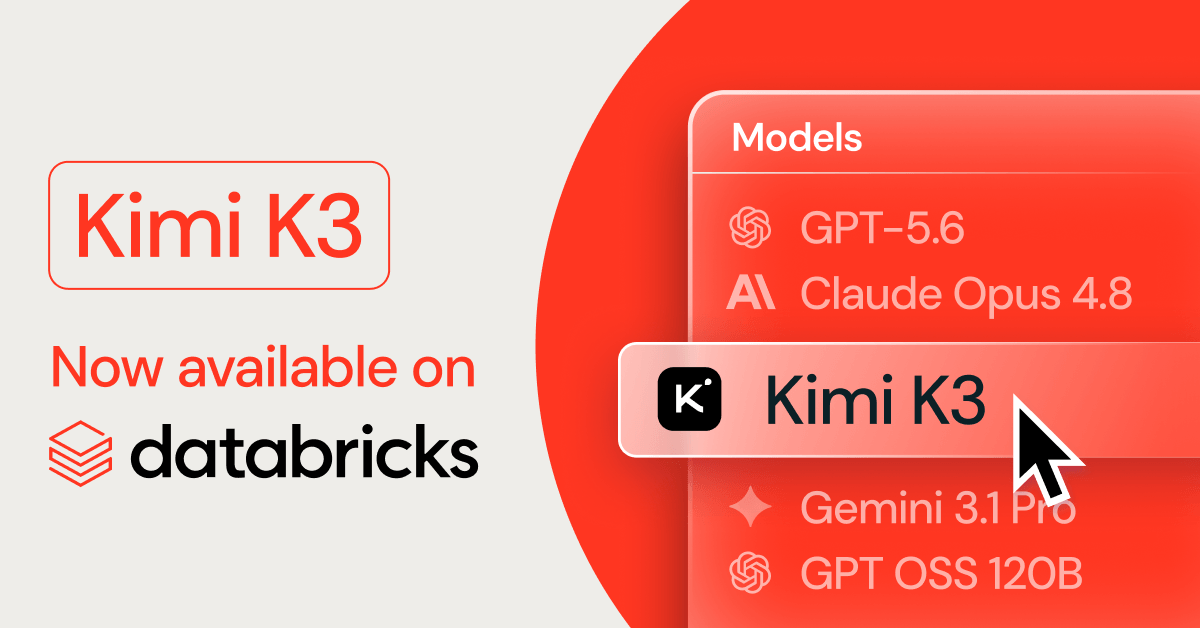
Moonshot AI’s Kimi K3, an open-weight model, is now available on Databricks, offering enterprises native access alongside proprietary models from Anthropic, OpenAI, and Google Gemini. The model delivers frontier-level performance on enterprise tasks such as coding, reasoning, and document understanding while maintaining full governance through Unity AI Gateway within Databricks’ secure environment. This integration addresses a key challenge for businesses by providing high-quality AI capabilities without compromising control or cost efficiency.
Kimi K3 ranks fourth in Artificial Analysis’ Intelligence Index with a score of 57, outperforming many comparable models. Databricks’ internal evaluations confirm that Kimi K3 performs consistently at the level of leading proprietary models. The model’s deployment flexibility and cost advantages—estimated at 50–72% lower cost-per-task—make it a viable option for large-scale enterprise workloads, including continuous coding agents and document processing pipelines.
Enterprise AI deployment on Databricks emphasizes four principles: context, control, choice, and cost. Kimi K3 operates directly against governed enterprise data via Unity Catalog, enabling agents to query lakehouses and feature stores while grounding responses in organizational knowledge. Unity AI Gateway provides fine-grained governance, safety guardrails, audit trails, and spend controls, ensuring consistent policies across all models, including Kimi K3.
Kimi K3 is available immediately on Databricks Foundation Model API with native access for AWS and GCP workspaces, and ADI access for Azure Databricks. Enterprises can test the model in the AI Playground, configure governance and routing via Unity AI Gateway, or build Kimi-powered agents using Agent Bricks. Additional support is available through account teams for capacity requests, regional availability, and model routing strategy.