Snowflake CoCo for Excel and Google Sheets: Governed AI
Snowflake’s CoCo coding agent now integrates governed Snowflake data and AI directly into Microsoft Excel and Google Sheets, enabling natural-language workbook creation and live data refreshes while preserving enterprise governance.
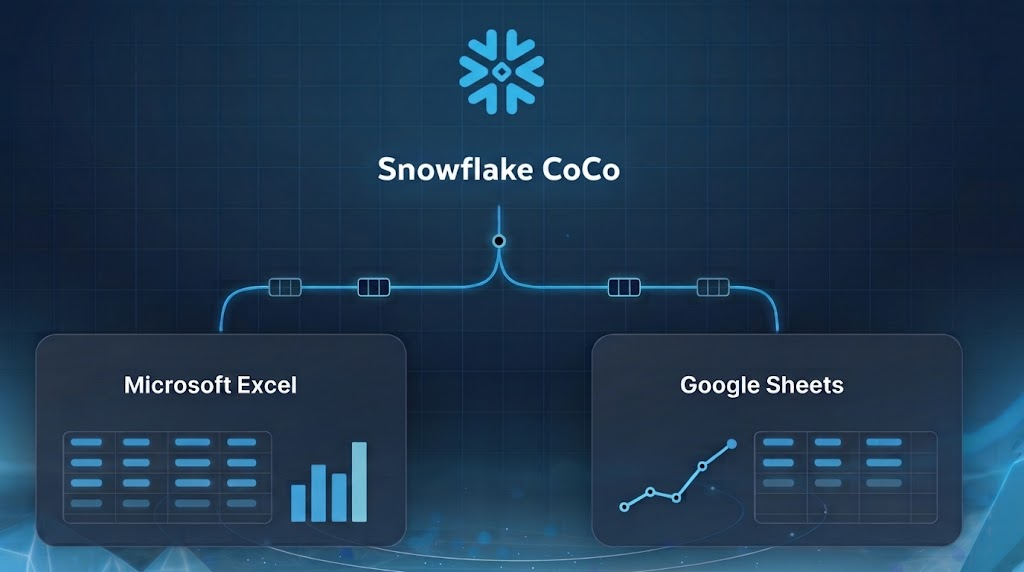
Snowflake CoCo introduces a coding agent for Microsoft Excel and Google Sheets that embeds governed Snowflake data, semantics, and AI capabilities within the familiar spreadsheet interface. Analysts can describe tasks in natural language and have CoCo generate workbooks with native formulas, charts, and pivot tables, eliminating manual data integration and formatting. The agent operates within existing permissions, ensuring enterprise governance is maintained while reducing reliance on disconnected data copies and traditional connectors.
CoCo eliminates the need for manual exports or third-party connectors by executing queries directly against Snowflake using the user’s assigned role and access controls. Results are written to spreadsheets as live data, with row-level security and masking policies applied. The agent also saves query text within the workbook, enabling intelligent refreshes that adapt to changing data volumes without disrupting existing formulas or objects, improving consistency and auditability of analyses.
The integration supports agentic workflows that go beyond chatbot responses, generating spreadsheet-native outputs such as CORTEX.CLASSIFY and CORTEX.SUMMARIZE functions in Excel cells. CoCo leverages Snowflake’s Semantic Views, Business Ontology, and Cortex Sense to ground analysis in company-specific definitions and relationships, ensuring trustworthy results. Complex calculations are offloaded to Snowflake’s virtual warehouses, allowing spreadsheets to handle large datasets without performance degradation.
Internal testing compared CoCo for Excel against an AI model harness using the Snowflake MCP across accuracy, latency, and output tokens for common spreadsheet tasks. CoCo demonstrated comparable accuracy with lower latency and fewer output tokens, reflecting its optimization for data workflows. The agent’s architecture prioritizes direct-to-sheet data transfers and model efficiency, enabling deeper analysis and faster insights while reducing manual effort in workbook creation and maintenance.