Business Ontology: Governed Context for AI
Snowflake introduces Business Ontology to standardize enterprise business terms, entities and metrics for consistent AI interpretation and reuse across tools.
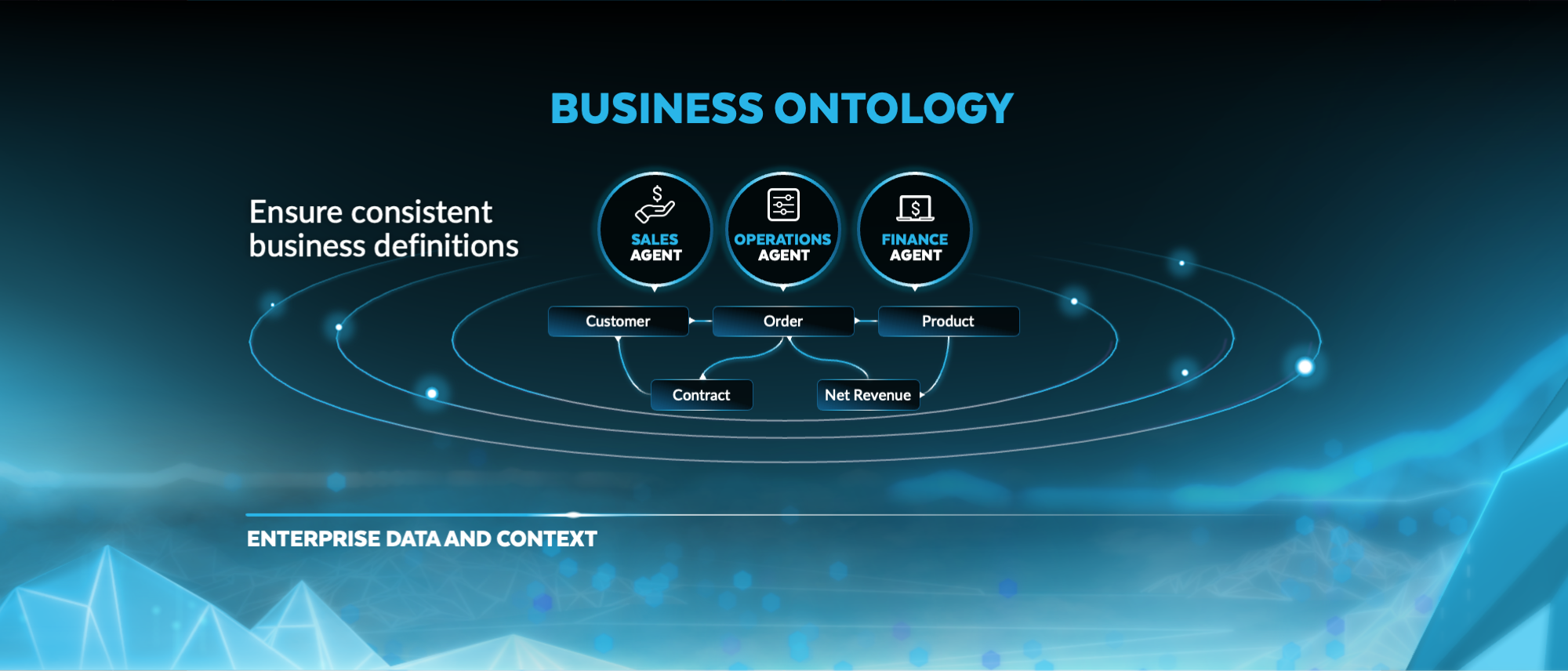
Business Ontology, part of Snowflake Horizon Context, enables teams to define, own and approve shared business terms, entities, relationships and metrics, ensuring AI agents and humans use the same definitions. This governed approach prevents misinterpretation of enterprise data by providing a single official source for critical terms like revenue, orders and customers, reducing errors in decision-making. Teams can reuse approved definitions across agents and applications without rebuilding context for each tool, preserving domain-specific variations where needed.
Horizon Context aggregates metadata from existing tools such as Tableau, Power BI, dbt, SQL Server, Sigma, Omni and PostgreSQL to create a connected view of the data estate. It uses out-of-the-box connectors to collect schemas, query logs, dashboard definitions and usage signals, then traces data lineage from source databases through transformations to dashboards. This cross-platform visibility helps teams understand data origins and usage both inside and outside Snowflake, supporting better governance and trust in analytics.
Snowflake offers three layers of context—Cortex Sense, Business Ontology and Semantic Views—each addressing distinct challenges in enterprise data interpretation. Cortex Sense automatically infers context from everyday work like queries and dashboards, reducing manual modeling. Business Ontology governs the most important business terms with accountable ownership, while Semantic Views define how metrics are calculated. Teams can start with any layer based on their immediate needs and integrate the others as requirements evolve.
Semantic Views package domain metrics, dimensions and joins into Snowflake objects that agents, BI tools and SQL can query directly, ensuring consistent metric calculations. Business Ontology links approved definitions to these views without altering calculations, maintaining domain-specific implementations. Snowflake supports Apache Ossie, an open standard for semantic models, allowing metrics to move between Snowflake and other Ossie-compatible tools. Agents outside Snowflake can query Semantic Views via Model Context Protocol under Horizon Catalog governance.