APOD: 2026 August 26
NASA’s James Webb Space Telescope has released a detailed composite image of the Lion’s Head Nebula, offering new insights into the fate of Sun-like stars.
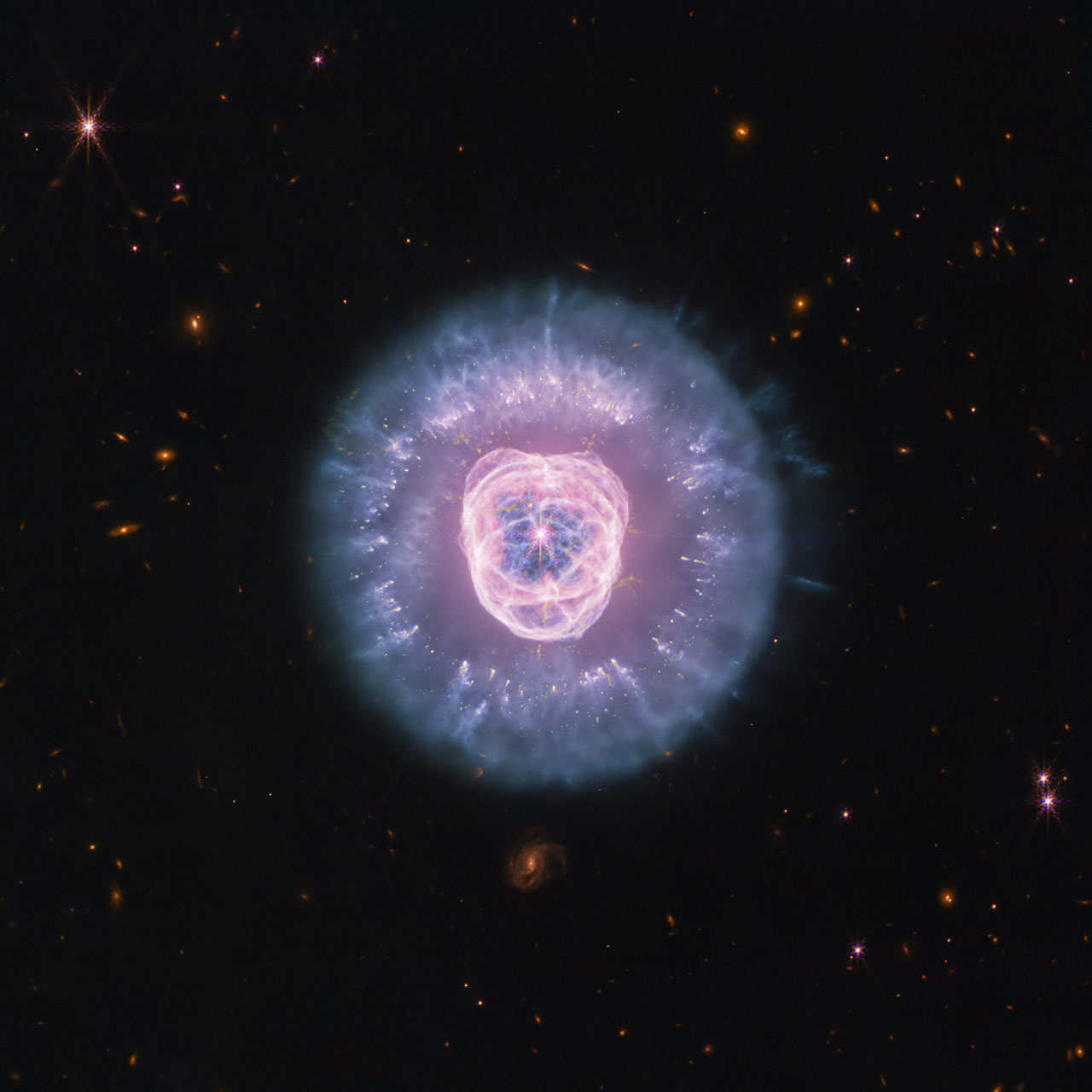
The James Webb Space Telescope captured a composite image of the Lion’s Head Nebula (NGC 2392) using its NIRCam and MIRI instruments. This nebula is the remnant of a Sun-like star that exhausted its nuclear fuel, leading to the shedding of gas and dust layers. The image reveals a hot white dwarf at the nebula’s core, ionizing surrounding gas and creating a distinctive bubble shape. Researchers anticipate the data will enhance understanding of stellar evolution and nebular dynamics.
The Lion’s Head Nebula, located in the constellation Gemini, represents a late stage in the life cycle of stars similar to our Sun. The nebula’s structure includes surviving dust clumps and ionized gas, forming what appears as a lion’s mane. Astronomers note that studying such nebulae provides critical clues about the processes governing stellar death and the dispersal of cosmic material. The James Webb Space Telescope’s instruments enable unprecedented clarity in observing these phenomena.
This detailed view of the nebula highlights the interaction between stellar radiation and ejected material. The white dwarf’s intense radiation ionizes the expanding gas, creating irregular patterns visible in the image. Scientists aim to use these observations to refine models of planetary nebula formation and evolution. The data may also shed light on the chemical composition of the nebula and its role in enriching the interstellar medium.
The image is part of NASA’s Astronomy Picture of the Day (APOD) series, which features a new astronomical image or photograph daily. Each entry includes an explanation written by a professional astronomer. Tomorrow’s APOD will showcase a different celestial phenomenon, continuing the series’ tradition of public outreach and scientific education.