APOD: 2026 August 7
NASA’s Rubin Observatory has released a deep-sky image of over half a million galaxies in the COSMOS field, offering new insights into galactic evolution and cosmic structure.
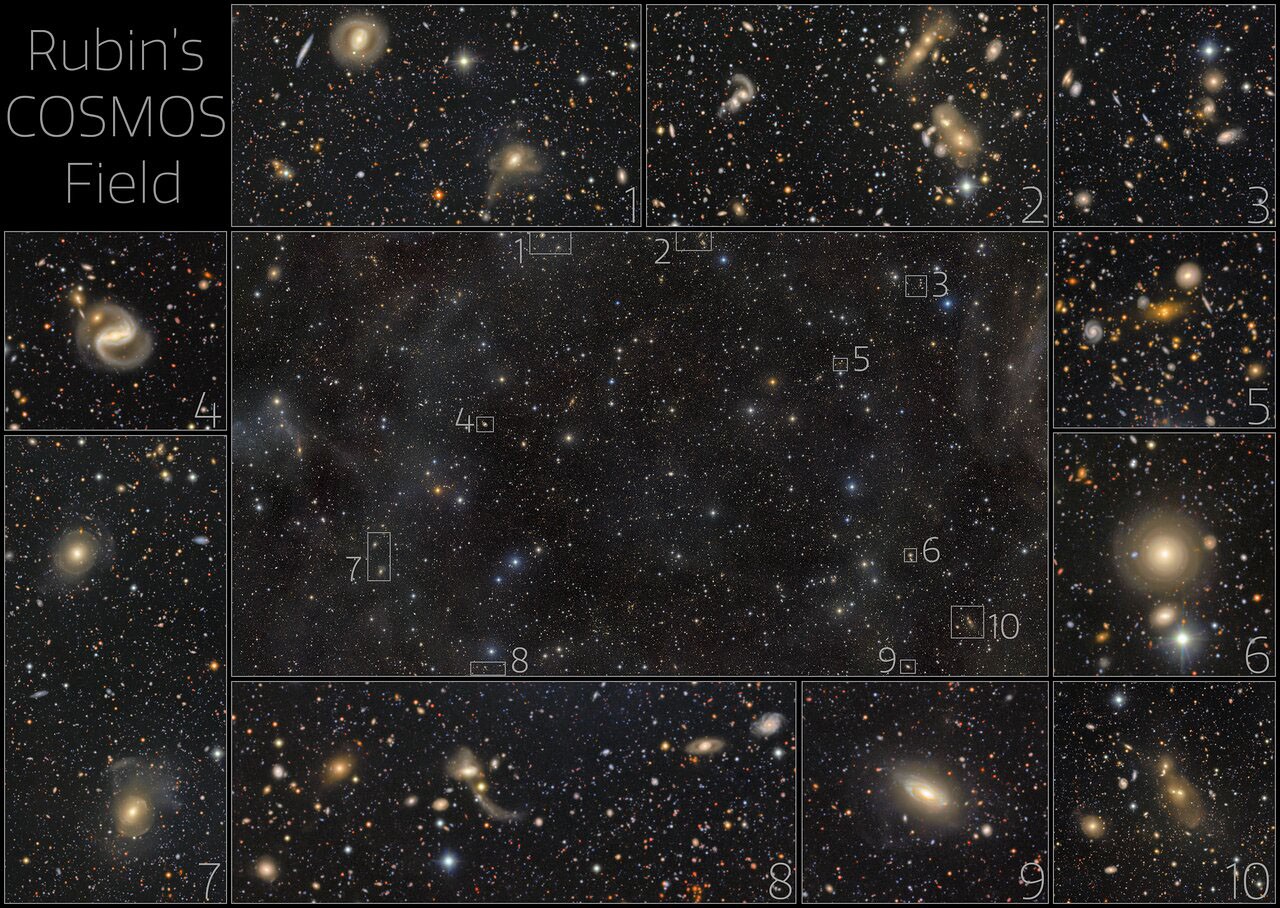
The Vera C. Rubin Observatory in Chile has captured an image of more than 500,000 galaxies in the COSMOS field, a region of the sky first studied by the Hubble Space Telescope. The image, part of the observatory’s early data release, highlights the diversity of galaxy shapes and sizes, including distant galaxies whose light has traveled billions of years to reach Earth. The COSMOS field was selected for its relatively clear view of extragalactic space, with fewer bright stars from the Milky Way obstructing the view.
The central panel of the image provides a wide-field view of the COSMOS field, while the outer panels offer zoomed-in views of ten specific regions. These close-ups reveal intricate details of individual galaxies, showcasing the observatory’s ability to capture both broad and fine cosmic structures. The data will help astronomers study the formation and evolution of galaxies over cosmic time.
The Rubin Observatory, funded by the National Science Foundation and the U.S. Department of Energy, will conduct a ten-year Legacy Survey of Space and Time (LSST). As part of this survey, the observatory will revisit the COSMOS field every few days, enabling scientists to monitor changes in the sky over time. This dynamic approach will allow researchers to track transient events such as supernovae and variable stars.
The COSMOS field has been observed by multiple telescopes, including the James Webb Space Telescope, due to its unique properties. The Rubin Observatory’s repeated observations will complement these efforts by providing a time-domain perspective, offering new opportunities to study the universe’s most dynamic phenomena. The image and data are now available to the global astronomical community for further research.