Fire Cloud with a Pileus on Top
NASA scientists captured rare images of a transient pileus cloud atop a wildfire-driven pyrocumulus cloud over Montana in August 2026, revealing extreme updraft dynamics during the INSPYRE campaign.
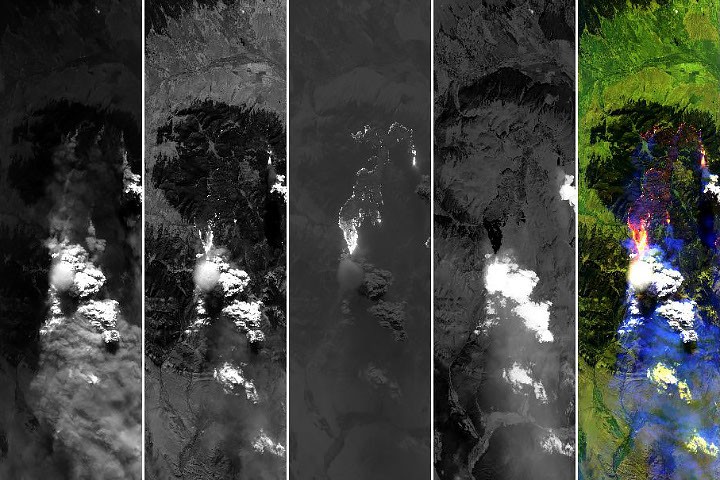
During a 2026 flight over Montana’s Sand Creek fire, NASA researchers intercepted towering smoke-infused clouds and unexpectedly documented a rare pileus cloud hovering above one. The smooth, veil-like cloud formed when a fast-rising fire plume displaced moist air aloft, cooling and condensing water vapor into a thin layer. Researchers noted the pileus cloud’s brief existence, lasting only minutes before convection disrupted it, highlighting the extreme dynamics within the fire’s plume.
The observations were made at 5:40 p.m. local time using NASA’s ER-2 aircraft equipped with the MASTER instrument, which captured both natural-color and shortwave-infrared images. The natural-color view revealed the circular pileus perched atop the smoke turret, while the infrared imagery exposed burned areas and active fire fronts along the perimeter. The team collected plume imagery roughly every 30 minutes, with the pileus visible in just one frame.
Neil Lareau, INSPYRE’s deputy project investigator, described the scene as a prime example of the campaign’s goals, linking surface fire behavior to convective plume and cloud processes. The alignment of winds with drainage channels up Mount Comet fueled the fire’s rapid spread, creating conditions for the pileus cloud’s formation. Lareau emphasized the rarity of such detailed observations of a pileus interacting with a pyrocumulus cloud.
Pileus clouds, though typically short-lived, can form above vigorous updrafts from thunderstorms, volcanic eruptions, or wildfires. NASA’s INSPYRE campaign aims to study these extreme convective clouds, which play a role in transporting smoke high into the atmosphere. The data collected during the flight will help scientists better understand the interplay between fire dynamics and atmospheric processes.