Physical AI Takes the Wheel: How the World’s Robotaxi Leaders Are Building With NVIDIA Technologies
NVIDIA’s AI platform powers global robotaxi fleets by integrating training, simulation and in-vehicle computing to scale autonomous driving safely and reliably.
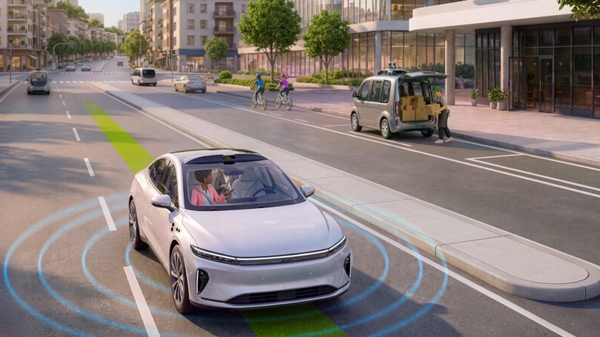
The robotaxi market is expanding rapidly, with commercial fleets already operating in dense urban areas, requiring scalable AI systems to maintain consistent safety and performance across thousands of vehicles. NVIDIA provides an open platform that supports the entire robotaxi development lifecycle, from training AI models to simulating and validating driving behavior, as well as real-time in-vehicle processing. Every major commercial robotaxi program relies on NVIDIA’s modular stack, which includes AI training, simulation and in-vehicle computing to deploy fleets at scale. The platform consolidates these capabilities into a three-computer solution: a model training computer, a simulation and validation computer, and an in-vehicle computer.
Robotaxi intelligence improves as programs leverage growing volumes of fleet data to train increasingly capable models, with NVIDIA DGX systems used for training and the Alpamayo portfolio offering open reasoning vision language action models and simulation frameworks. NVIDIA’s physical AI datasets and reinforcement learning tools help developers optimize models for their target vehicles, addressing challenges like long-tail driving scenarios by breaking complex situations into manageable steps. The platform also includes reinforcement learning blueprints and recipes for post-training optimization, enabling developers to refine models for specific vehicle requirements.
To capture rare driving scenarios, NVIDIA Omniverse NuRec reconstructs real-world scenarios from sensor data, while NVIDIA Cosmos world foundation models generate variations of these scenarios. These tools, running on NVIDIA RTX PRO Servers, enable developers to simulate millions of combinations of driving behavior, traffic, weather and sensor conditions for closed-loop validation. The NVIDIA AlpaSim simulation framework extends this workflow, allowing developers to train and evaluate reasoning-based autonomous driving models and identify weaknesses before deployment.
NVIDIA DRIVE Hyperion 10 provides a modular in-vehicle compute and sensor reference architecture for level-4-ready robotaxis, featuring dual NVIDIA DRIVE AGX Thor systems-on-a-chip, 14 high-definition cameras, nine radars, three lidars and 12 ultrasonics for 360-degree sensor fusion. Its redundant design supports fail-operational driving, and the dual DRIVE AGX Thor systems are built to run modern AI workloads, including perception, reasoning and path planning. NVIDIA Halos offers a production-ready safety foundation with Halos OS and a validation framework spanning inspection, system validation and continuous testing from cloud to car.