Sakeena Fiza Helps NVIDIA Hardware Succeed at Scale
NVIDIA validation engineer Sakeena Fiza uncovers hardware flaws before mass production, ensuring AI systems operate reliably at scale through rigorous testing and interdisciplinary collaboration.
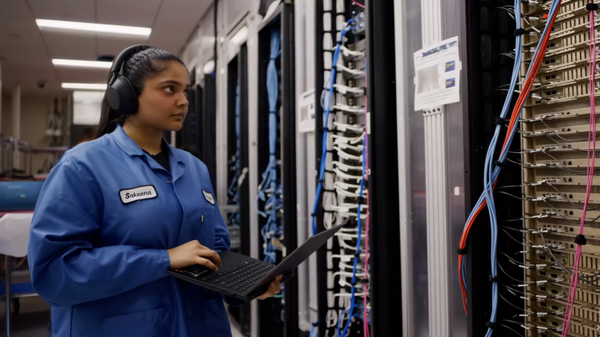
Sakeena Fiza, a validation engineer at NVIDIA, compares her role to solving detective mysteries, focusing on identifying potential failures in systems that power AI infrastructure. Her work begins in the lab, where new hardware components are integrated and tested for the first signs of functionality. Fiza recalls the excitement of seeing the NVIDIA Rubin GPU enumerate at the system level for the first time, marking a milestone in hardware validation. This moment underscores the collaborative effort among engineers to bring complex systems to life before they reach customers.
Validation at NVIDIA extends beyond initial functionality, requiring engineers like Fiza to stress-test systems across multiple stages, from individual trays to full production clusters. The process ensures hardware resilience under real-world conditions before deployment in customer AI factories. Fiza emphasizes that validation engineers act as the first customers, catching issues early to prevent failures downstream. Her approach involves exhaustive testing, including high-speed signaling, thermal behavior, and mechanical integrity, to uncover even microscopic flaws.
Fiza’s journey to NVIDIA began with a fascination for systems design, cultivated through early coding experiences and hands-on projects like building Mars rovers and unmanned aerial vehicles. Her role allows her to engage with diverse engineering disciplines, from mechanical and electrical engineering to firmware development. This interdisciplinary exposure enables her to diagnose failures ranging from rack-scale issues to minor mechanical misalignments, such as screws or dust accumulation in customer facilities.
The complexity of modern AI hardware demands meticulous validation, as a single board may contain tens of thousands of components and a rack nearly half a million. Fiza describes the validation process as a disciplined pursuit of failure modes, requiring detective-like persistence to reproduce and diagnose issues. Her work is driven by the belief that rigorous testing ensures systems behave as one under stress, ultimately delivering reliable infrastructure for AI applications. Fiza expresses optimism about upcoming products, highlighting the critical role validation plays in shaping the future of AI technology.