Italian startup unveils double-layer PV system prototype for space-constrained applications
An Italian research team and startup developed a double-layer PV system with independent tracking for each layer, aiming to boost energy yield in space-constrained applications like utility-scale and agrivoltaic projects.
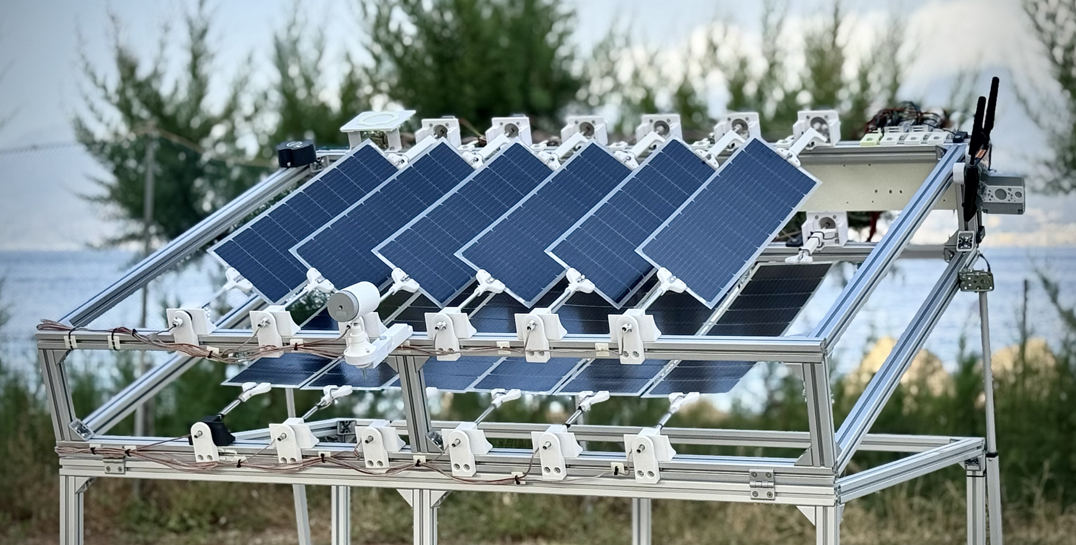
A team from Italy’s Mediterranea University of Reggio Calabria and startup AMPS Srl created a double-layer photovoltaic system designed to maximize energy output from limited land areas. The prototype uses two vertically stacked layers of PV modules, each with independent single-axis tracking, to capture direct, diffuse, and reflected solar radiation while minimizing mutual shading. The system was installed in Reggio Calabria, southern Italy, occupying the same footprint as a single-layer installation but providing twice the active PV surface.
The prototype incorporates 12 custom bifacial TOPCon mini modules, with six in each layer, specifically designed to isolate the behavior of overlapping surfaces. The layers are vertically separated by 25 cm to create controlled shading conditions for testing. An automated system synchronizes module rotation, current measurements, and data collection, enabling real-time performance monitoring under identical environmental conditions.
Researchers tested three operating modes to evaluate performance trade-offs. Mode 1, where the bottom layer remained fixed and the top layer tracked the sun, achieved a 27% gain in short-circuit current over a bifacial single-layer reference and 42% over a monofacial reference. Mode 2, with the top layer fixed and the bottom layer tracking, produced a 21% gain over the bifacial reference, while Mode 3, with both layers fixed in orthogonal orientations, showed gains of 14% and 28% respectively.
The architecture is designed to be adaptable to emerging PV technologies like perovskite and tandem cells, with plans to explore utility-scale and agrivoltaic applications. AMPS aims to validate the system under varied conditions and develop AI-based tracking strategies to further enhance energy yield per unit of land, while conducting longer-term testing for techno-economic assessments.