For Brazil’s Indigenous youth, visibility is resistance
Brazilian Indigenous youth are using digital platforms and cultural expression to resist climate change and land loss, ahead of the UN’s International Day of the World’s Indigenous Peoples.
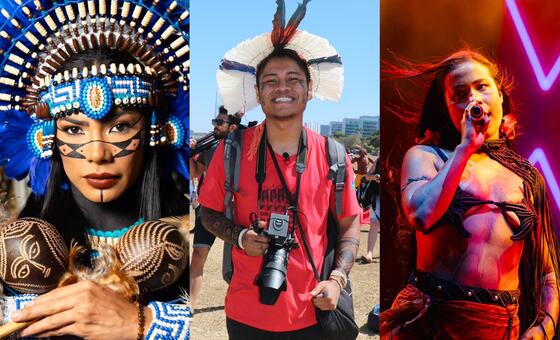
Climate change is intensifying threats to Indigenous territories in Brazil, with rising temperatures, food scarcity, and uncontrollable wildfires reshaping daily life. Three young leaders—Marciele Albuquerque (Munduruku), Kaê Guajajara (Guajajara), and Cristian Wariu (Xavante)—are responding by leveraging social media, music, and photography to amplify their voices and counter misinformation. Their efforts align with the UN’s Verified initiative, which aims to address climate-related disinformation. For many, these creative tools are not just forms of expression but acts of survival in the face of environmental and territorial crises.
The impacts of climate change on Indigenous communities are well-documented, with the UN estimating over 370 million Indigenous people worldwide already affected. Kaê Guajajara, raised in Rio de Janeiro’s Maré favela, argues that today’s environmental crisis stems from development models imposed on Indigenous peoples. She views music as both a cultural anchor and a means to challenge misinformation, noting that traditional songs now reflect the harsh realities of deforestation and displacement. Her work underscores the need for stronger public policies to support Indigenous populations in urban areas.
Cristian Wariu, from the Xavante people in Mato Grosso, highlights how worsening wildfires in the Cerrado biome disrupt food chains and health within Indigenous communities. He emphasizes that the fight for Indigenous rights has evolved beyond political demarcation to include digital spaces. "Demarcation is no longer just about politics. It’s also about occupying screens," he said, stressing the role of communication in the current generation’s activism. His generation’s focus on visibility is seen as a strategic complement to earlier efforts securing constitutional rights.
Marciele Albuquerque, the first Indigenous woman to earn the Cunhã-Poranga title at Brazil’s Parintins Folklore Festival, uses dance to celebrate Indigenous diversity and resist environmental degradation. Her winning performance, *Guerreira das Lutas*, and Kaê’s song *Samaúma* exemplify how art and technology intersect in Indigenous resistance. Both reject narratives that Indigenous identity is incompatible with modernity, arguing that cultural expression—whether through maracá or synthesizers—reinforces resilience. Their message is clear: challenges are strengthening, not weakening, their communities.