Managing AI Coding Costs at Scale
Databricks and other large-scale AI adopters outline cost-control strategies for AI coding tools, emphasizing model efficiency, flexible tooling, and progressive spend management to balance productivity gains with budget constraints.
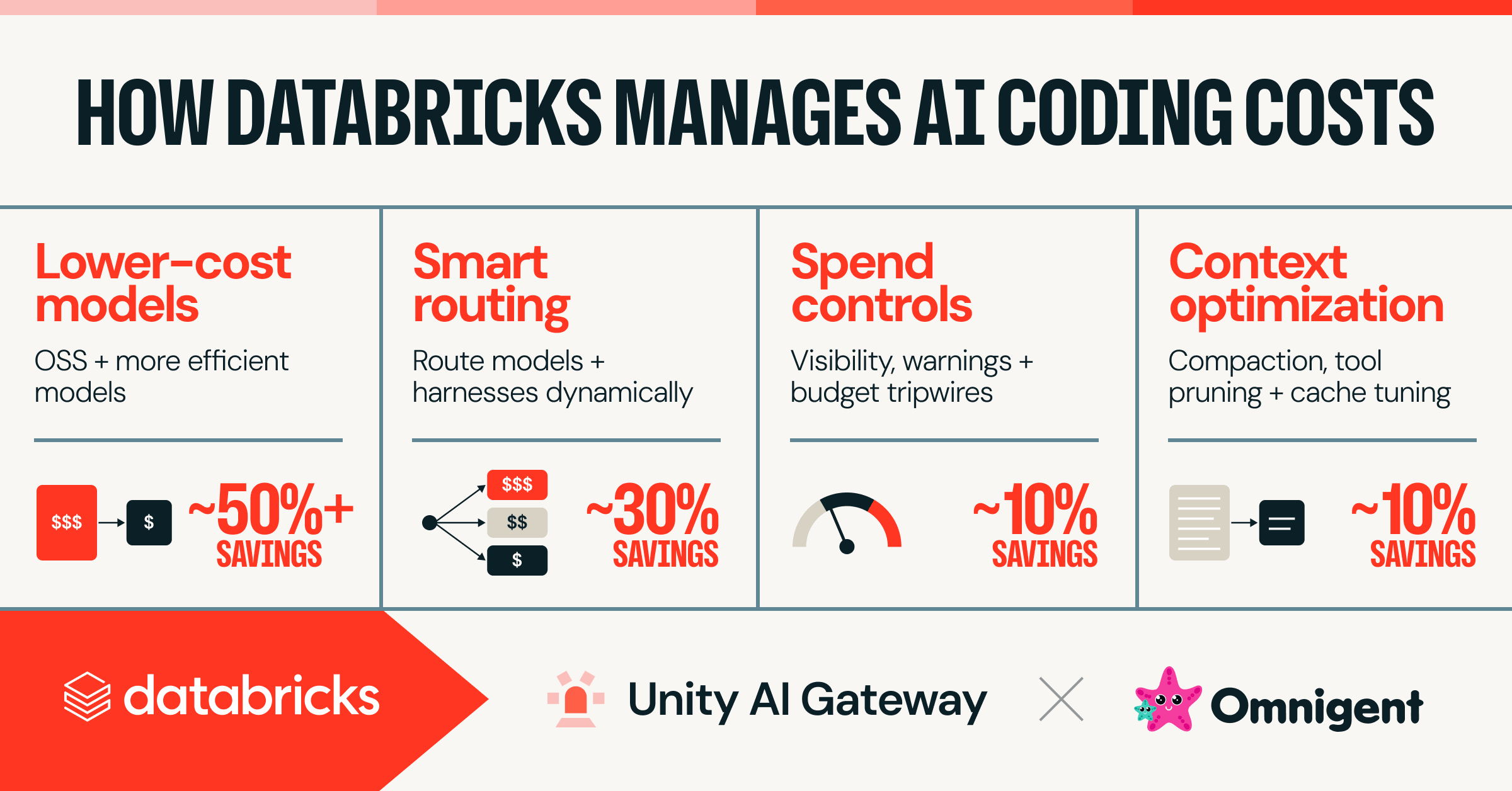
AI coding tools have delivered significant productivity gains, but their rising costs threaten to undermine these benefits. Companies deploying these tools at scale face an unsustainable spending curve that could eventually exceed revenue. Early adopters, including Databricks, Stripe, Coinbase, Uber, and Ramp, have developed cost-management techniques to maintain broad access to AI tools while keeping expenses predictable. These approaches include adopting newer, more efficient models, using meta-harnesses for model flexibility, and implementing progressive spend controls rather than hard caps.
The most impactful cost-saving measure is rapidly adopting newer models that offer better price-to-performance ratios for typical coding tasks. Companies are increasingly evaluating models based on internal benchmarks rather than public metrics, as these better reflect real-world performance. For example, Databricks found GLM models competitive in price/performance and rolled them out internally, while Stripe and Databricks both observed cost regressions with certain proprietary models, leading to their rejection. Flexible tooling, such as meta-harnesses like Databricks' Omnigent, allows developers to use preferred interfaces while enabling seamless model switching to lower-cost options.
Hard spending caps are ineffective for AI tool management, as cutting off high-performing users would harm productivity. Instead, companies are adopting progressive friction and visibility tools, such as real-time spend feedback and tips for cost reduction. Context bloat—where excessive data inflates costs—is a major driver of spending. Techniques like prompt caching and tuning harness settings have reduced token generation by nearly 50% at Databricks without quality loss. These optimizations require infrastructure that centralizes model management, cost observability, and context control, often through AI gateways like Databricks' Unity AI Gateway.
The exponential growth of AI coding costs is addressable through a combination of engineering and governance strategies. Companies that have successfully managed costs focus on the efficiency frontier, preserve model flexibility, route work to the cheapest capable model, and replace hard budgets with visibility and progressive friction. Databricks has open-sourced key components of its cost management stack, including Unity AI Gateway and Omnigent, to help others adopt these techniques. The company invites broader collaboration as the technology landscape evolves.