How the Advanced Light Source Is Accelerating Our Quantum Future
The Advanced Light Source at Lawrence Berkeley National Laboratory is upgrading its synchrotron to enable nanoscale measurements of quantum materials, supporting advances in quantum computing, spintronics, and neuromorphic computing.
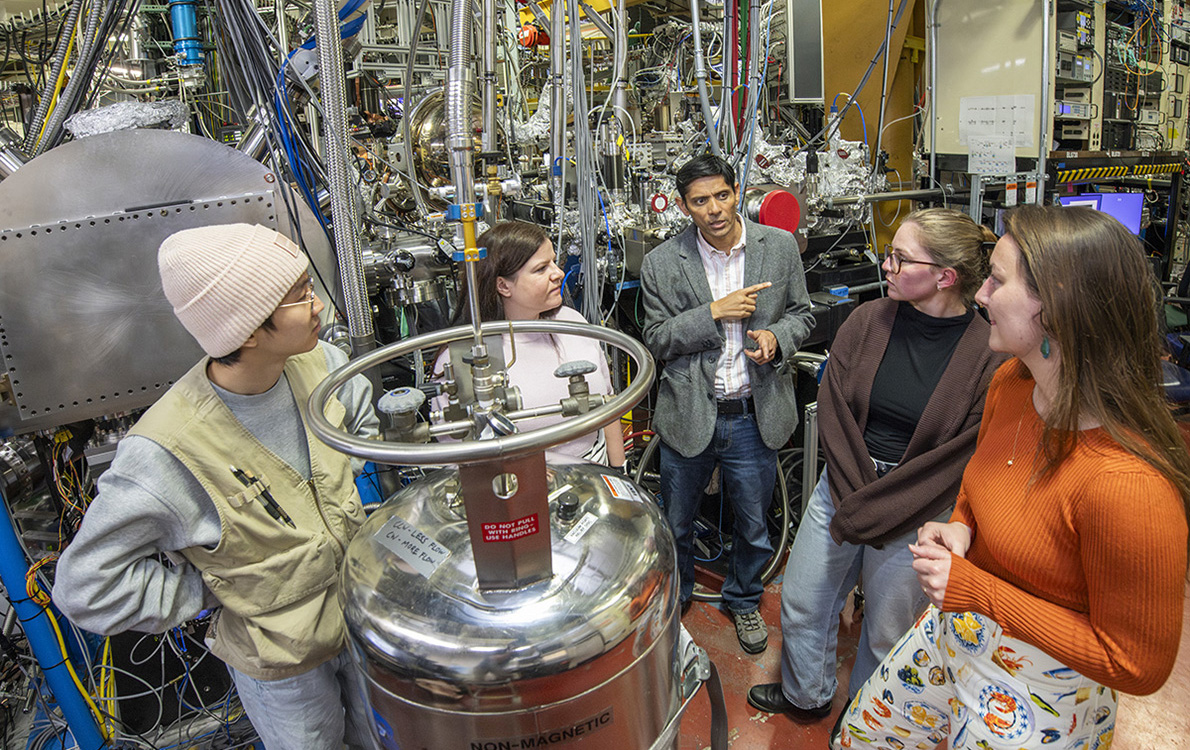
The Advanced Light Source (ALS), a Department of Energy user facility at Lawrence Berkeley National Laboratory, has advanced quantum materials research for over 30 years by providing X-ray light tools that reveal emergent electronic behaviors. Its Angle-Resolved Photoemission Spectroscopy (ARPES) instruments have helped identify phenomena like superconductivity and exotic magnetism, contributing to discoveries such as graphene insights and one-atom-thin magnets. These tools have also aided in developing qubits from 2D metal organic frameworks for quantum computing.
A major ALS upgrade, ALS-U, will produce brighter, more coherent X-ray beams focused to less than 25 nanometers, enabling direct observation of quantum states and defects within billionths of a second. The upgrade will enhance ARPES techniques, including spin-resolved measurements, improving energy resolution and stability. Researchers like Riccardo Comin of MIT and Ming Yi of Rice University have used ALS instruments to study superconductivity and spintronics, with the upgrade expected to expand these capabilities further.
The ALS-U upgrade will also introduce new instruments like FLEXON, which combines X-ray photon correlation spectroscopy and a coherent X-ray reflection microscope to study nanoscale charge and spin patterns in quantum materials. These tools will support research into neuromorphic computing, a technology inspired by neural networks that aims to improve energy efficiency in computing. Alex Frañó of UC San Diego is among researchers exploring these applications.
The ALS Upgrade Project is designed to address challenges in quantum materials research, such as measuring quantum coherence in qubits and understanding electron behavior in superconductors and magnets. By enabling nanoscale control and observation, the upgrade will help researchers develop materials with tailored properties for next-generation electronics, quantum computing, and advanced computing technologies.