Partnering with Industry to Accelerate Quantum Computing
Berkeley Lab partners with industry and academia to advance quantum computing through testbeds, workforce training, and shared facilities, supporting scalable quantum networks and hardware development.
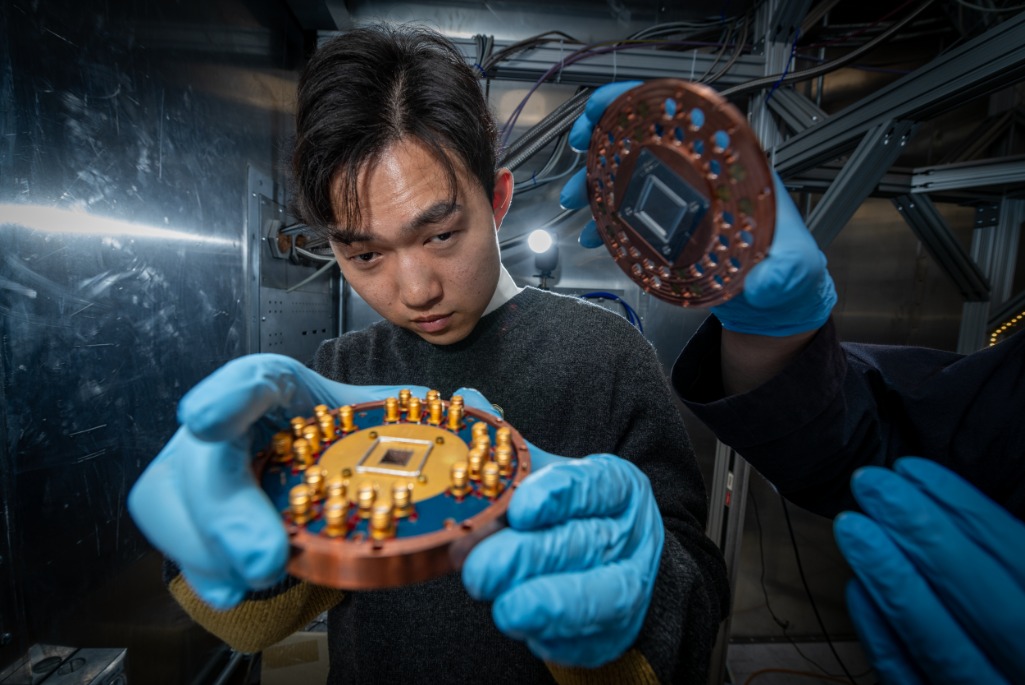
Berkeley Lab leads QUANT-NET, a DOE-funded testbed linking Berkeley Lab, UC Berkeley, and Caltech via a 5 km fiber network to distribute quantum entanglement. The project, involving ESnet and international collaborators, provides industry partners with modular software and custom-built ion-trap nodes optimized for quantum communications. Recent advancements include quantum frequency conversion to telecom bands and a two-level modular network software platform, recognized with a best paper award at IEEE Quantum Week 2025.
The Quantum Systems Accelerator (QSA), led by Berkeley Lab and Sandia National Laboratories, develops quantum devices using trapped ions, superconducting systems, and neutral atoms. Since 2020, QSA has delivered hardware to companies like QuEra and licensed flex cable technologies, while demonstrating a 256-atom quantum simulator. The open-source QubiC control system supports scalable benchmarking and algorithm development, with industry partners including NVIDIA’s NVQLink gaining access to national user facilities and rapid design capabilities.
NERSC’s QIS @ Perlmutter program has awarded over 500,000 compute hours to 30+ quantum information science projects since 2022, supporting research in quantum simulation and error mitigation. The center also provides access to quantum computers at IBM and QuEra Computing for select users. Collaborations with companies such as NVIDIA, Xanadu, and Rigetti focus on quantum simulation, chemistry, and materials science, accelerating large-scale quantum research through high-performance computing.
The Molecular Foundry and Advanced Light Source (ALS) advance quantum materials research by enabling atomic-scale synthesis, characterization, and visualization of quantum states. The Foundry’s QIS cluster tool and upcoming dilution refrigerator support qubit component development, while ALS’s X-ray and infrared beams probe superconductors and topological insulators. Berkeley Lab’s workforce initiatives, including QSA’s training programs and QCaMP summer camps, prepare over 250 students and educators annually for quantum careers, with plans to expand partnerships with community colleges in 2026.