Scientists Reveal Hidden Structure of a Quantum Fluid
Researchers at Lawrence Berkeley National Laboratory observed a tunable Bose-Einstein condensate of excitons in an atomically thin semiconductor, revealing an internal structure switchable by magnetic fields.
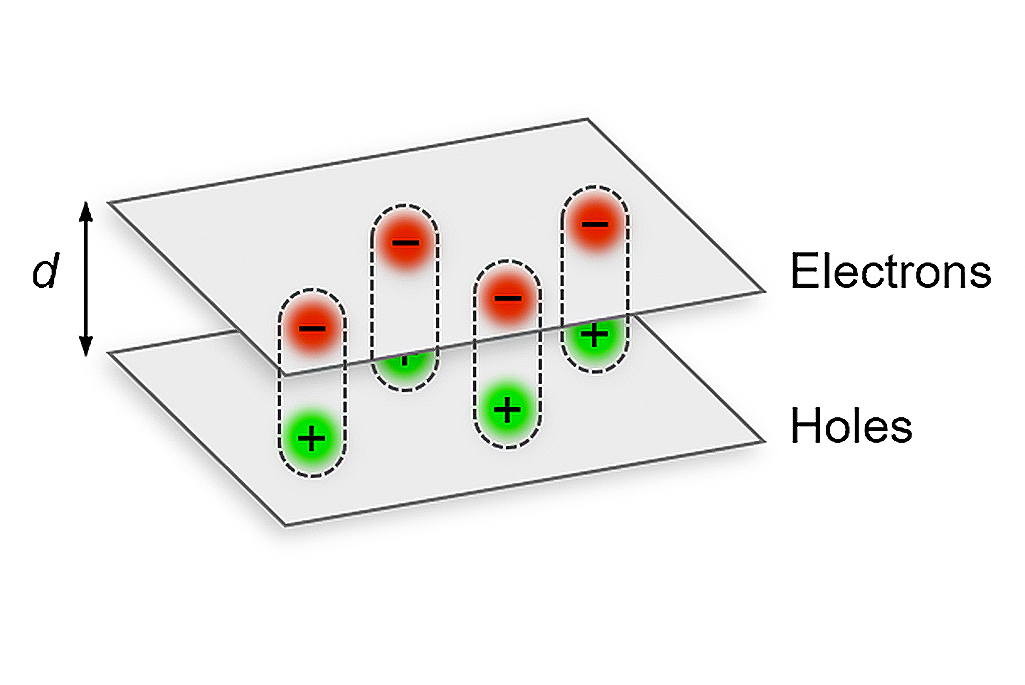
Bose-Einstein condensates (BECs) represent a quantum state where particles behave as a single collective entity, and excitons—electron-hole pairs—have long been sought as a solid-state route to such coherence. While traditionally created in ultracold gases, a team led by Lawrence Berkeley National Laboratory has now observed a tunable BEC of excitons at high temperature in a two-dimensional semiconductor, a breakthrough published in Nature. The discovery demonstrates that excitons can form a BEC in a controllable solid-state device, overcoming the challenge of their typically short lifespans when generated optically.
The researchers engineered a semiconducting device where excitons exist in the ground state rather than as transient excited states, enabling them to reach equilibrium and persist as a BEC. Using magneto-optical spectroscopy at near-absolute zero temperatures, they measured how electron and hole components responded to magnetic fields, while electrical gates tuned exciton density. The condensate signatures persisted up to approximately 2 Kelvin, millions of times warmer than prior BEC demonstrations in ultracold atomic gases, offering a more accessible platform for quantum studies.
The BEC exhibited an unexpected internal structure with two distinct components, each characterized by different spin–valley configurations—quantum properties tied to electron motion within the material. This multi-flavor condensate can be switched between quantum states by applying a small magnetic field, a feature the team described as unusual and controllable. The findings provide a direct method to access the hidden quantum order of exciton condensates, addressing a long-standing challenge in the field.
The discovery opens new avenues for quantum simulations, coherent optoelectronics in telecommunications and computing, and exciton-based devices for faster, more efficient technologies. The research, supported by the DOE Office of Science, involved collaborators from UC Berkeley, the University of Texas at Austin, and Japan’s National Institute for Materials Science. Future work aims to develop superfluid-based quantum devices and circuits using the exciton BEC platform.