How the Genesis Mission’s American Science Cloud Advances Innovation
The U.S. Department of Energy’s American Science Cloud, launched in October 2025 as part of the Genesis Mission, unifies DOE lab data and computing into an AI-ready platform to accelerate scientific discovery.
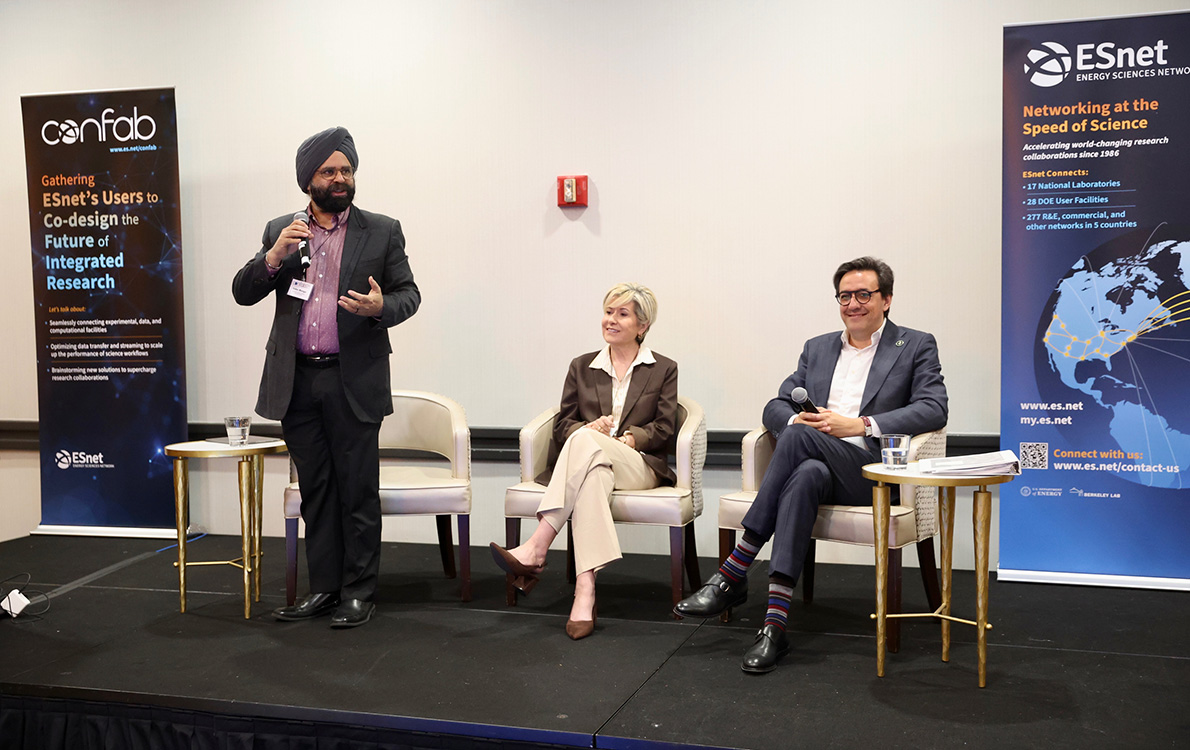
The American Science Cloud (AmSC), launched in October 2025 under the Genesis Mission, integrates data and high-performance computing from 17 DOE national labs and 28 user facilities into a single AI-ready platform. Inder Monga, Berkeley Lab’s ESnet Executive Director and AmSC Deputy Project Lead, highlights its role in addressing fragmented access and enabling autonomous scientific discovery through a unified identity layer and interoperable services. The platform extends connectivity to commercial cloud services and frontier AI models, supporting data-intensive research across disciplines.
Berkeley Lab leads AmSC’s development through project leadership, science use cases, and infrastructure contributions. Projects like SYNAPS-I embed AI into particle accelerators to reduce data analysis from months to near real time, while OPAL and MOAT advance autonomous laboratory capabilities. Berkeley Lab staff serve on the AmSC Science Council and contribute to architecture, software integration, and prioritization based on real-world research needs from facilities such as the Advanced Light Source and Joint Genome Institute.
Berkeley Lab’s role in AmSC is structured around three pillars: user-driven innovation, core infrastructure, and software integration. Researchers define science use cases to guide platform development, ensuring immediate value for the scientific community. The lab integrates high-performance computing from NERSC with ESnet’s next-generation networking to create a cohesive environment for data-driven research, while harmonizing diverse experimental data streams to support AI-ready infrastructure.
As part of the Genesis Mission, Berkeley Lab contributes to the Transformational AI Models Consortium alongside its AmSC efforts. The lab’s expertise in materials, chemistry, physics, and computing supports the DOE’s broader goals of advancing discovery science and reliable energy solutions. Managed by the University of California for the DOE’s Office of Science, Berkeley Lab’s work aligns with national priorities in addressing pressing scientific and energy challenges through collaborative, team-based research.