Introducing the Microsoft Copilot harness in Foundry Agent Service
Microsoft introduces the Copilot harness in Foundry Agent Service to simplify agent development by providing a managed execution system for complex, long-running tasks, now in public preview.
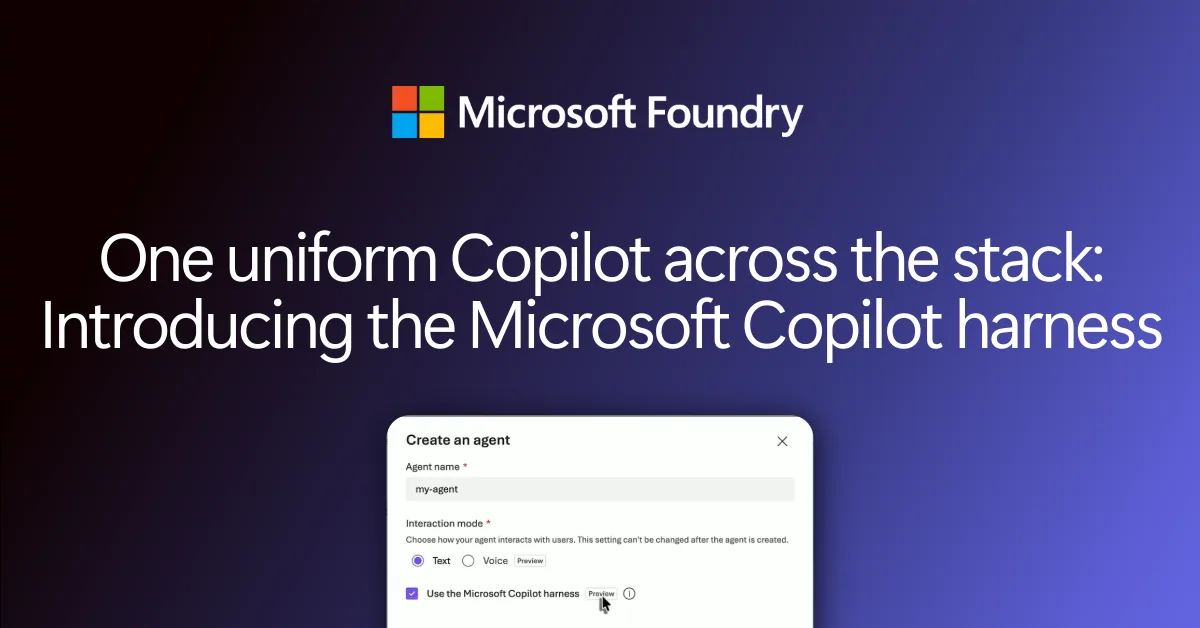
Microsoft’s new Copilot harness in Foundry Agent Service offers developers a fully managed execution system for building agents that reason, use tools, and complete multi-step tasks without assembling the underlying infrastructure. The harness manages the agent loop, working context, and tool coordination within configured policy boundaries, allowing teams to focus on refining agent expertise rather than infrastructure. Developers can choose from supported Foundry models without rewriting orchestration logic, streamlining the process of deploying reliable agents for workflows like market research or operational analysis.
The announcement includes general availability of long-running resilience for hosted agents, enabling recovery from interruptions during extended tasks by restarting work from the last checkpoint while preserving progress. This feature supports workflows that span hours or days, such as dataset analysis, by detecting interruptions and resuming with original inputs. Developers must implement safeguards to prevent duplicate actions, such as checking for existing reports before recreating them, while Foundry provides the recovery infrastructure.
Developers can start building agents using the Copilot harness in the Foundry portal, via the Azure Developer CLI (azd), or with the Foundry Toolkit for Visual Studio Code, with additional options through the GitHub Copilot app and Foundry plugin. The harness allows teams to define agents declaratively, choosing the level of abstraction that fits their application’s needs rather than managing unnecessary infrastructure. Existing agents remain unaffected, and switching harnesses after creation is not yet supported.
Billing for the Copilot harness begins December 1, 2026, with consumption-based pricing of $0.0994 per vCPU-hour and $0.0118 per GiB-hour for sandbox compute and memory, while model inference and external tools retain separate charges. The harness runtime usage is free until December 1, with prices subject to regional and agreement variations. The service is designed to reduce the engineering burden on teams building agents for complex, long-running workflows.