NASA’s IXPE May Have Proven 90-Year-Old Theory
NASA’s IXPE mission may have confirmed a 90-year-old quantum theory by detecting vacuum birefringence in observations of magnetar 1E 1547-5408.
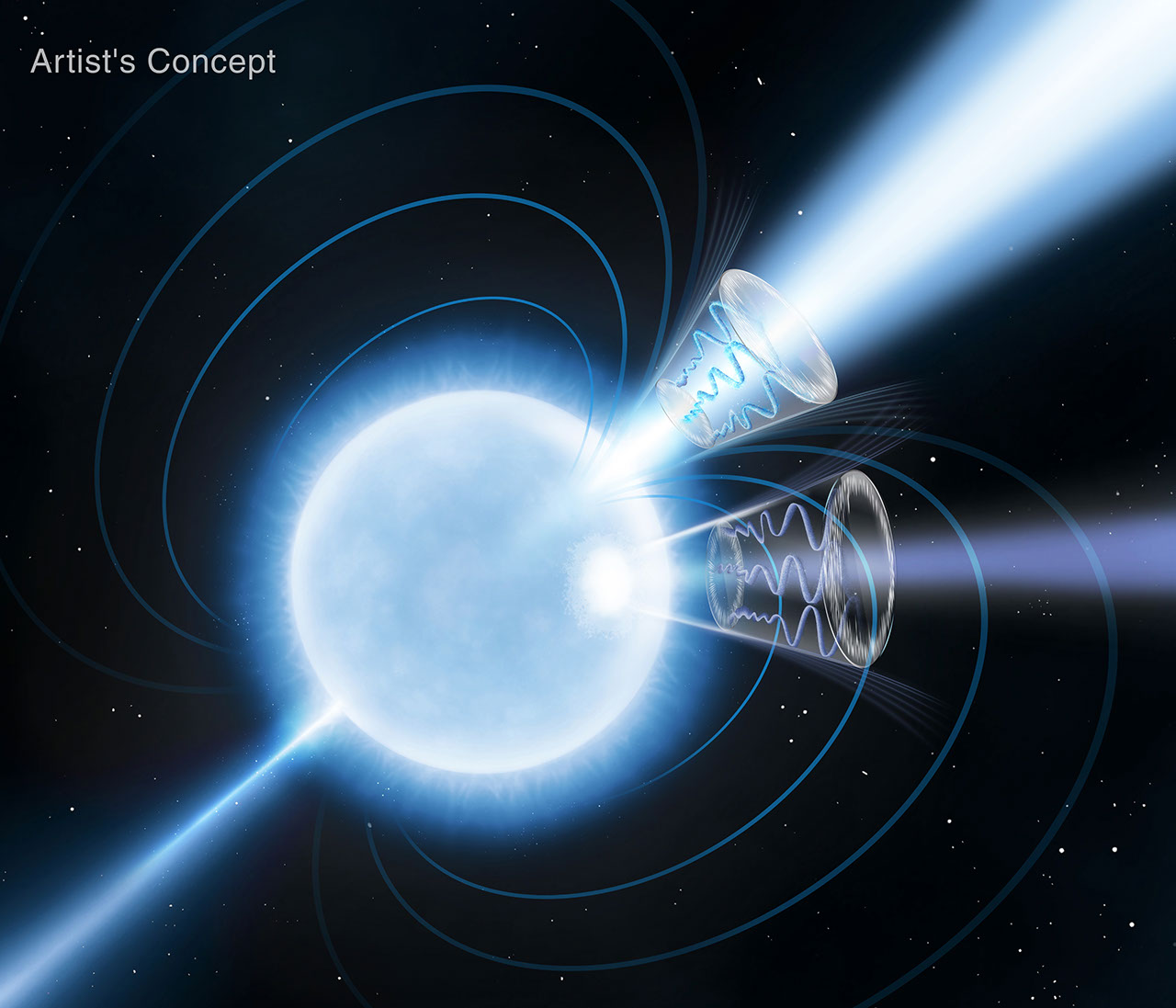
NASA’s Imaging X-ray Polarimetry Explorer (IXPE) conducted 140 hours of observations of magnetar 1E 1547-5408 in 2025, alongside NICER and Australia’s Murriyang radio telescope. The team measured unprecedented polarization levels in X-ray light, nearly three times higher than similar sources. This unexpected result challenged existing models of magnetar emissions, prompting researchers to explore alternative explanations. The findings suggest that extreme magnetic fields may alter the vacuum of space, acting as a lens to enhance light polarization, a phenomenon predicted by quantum electrodynamics in 1936.
The study, published in Nature, proposes that vacuum birefringence—where space itself behaves like a prism under intense magnetic fields—could explain the observed polarization. Simulations by the research team supported this theory, indicating that the magnetar’s environment may be amplifying the effect. Hoa Dinh Thi of Rice University noted that neutron stars provide a unique laboratory to test fundamental physics beyond Earth’s capabilities, emphasizing the role of extreme cosmic conditions in validating theoretical predictions.
Lead author Rachael Stewart of George Washington University described the discovery as a demonstration of astrophysics’ interdisciplinary power, linking distant observations to the fundamental nature of reality. The results mark the first potential direct detection of vacuum birefringence, offering new insights into quantum electrodynamics. Further IXPE observations of magnetars aim to confirm the signal and uncover additional exotic quantum effects, expanding our understanding of the universe’s fabric.
The IXPE mission, a collaboration between NASA and the Italian Space Agency with international partners, continues to deliver groundbreaking data on celestial objects. Managed by NASA’s Marshall Space Flight Center and BAE Systems, Inc., with operational support from the University of Colorado, IXPE remains a critical tool for probing extreme cosmic environments. The mission’s findings underscore the importance of polarimetry in advancing astrophysical research and testing long-standing theoretical models.