NASA Space Telescope Maps Magnetic Fields of ‘Lighthouse’ Pulsar
NASA’s IXPE telescope has directly measured the magnetic fields of pulsar PSR J1101−6101 within the Lighthouse Nebula, revealing new details about particle behavior and magnetic structures in extreme cosmic environments.
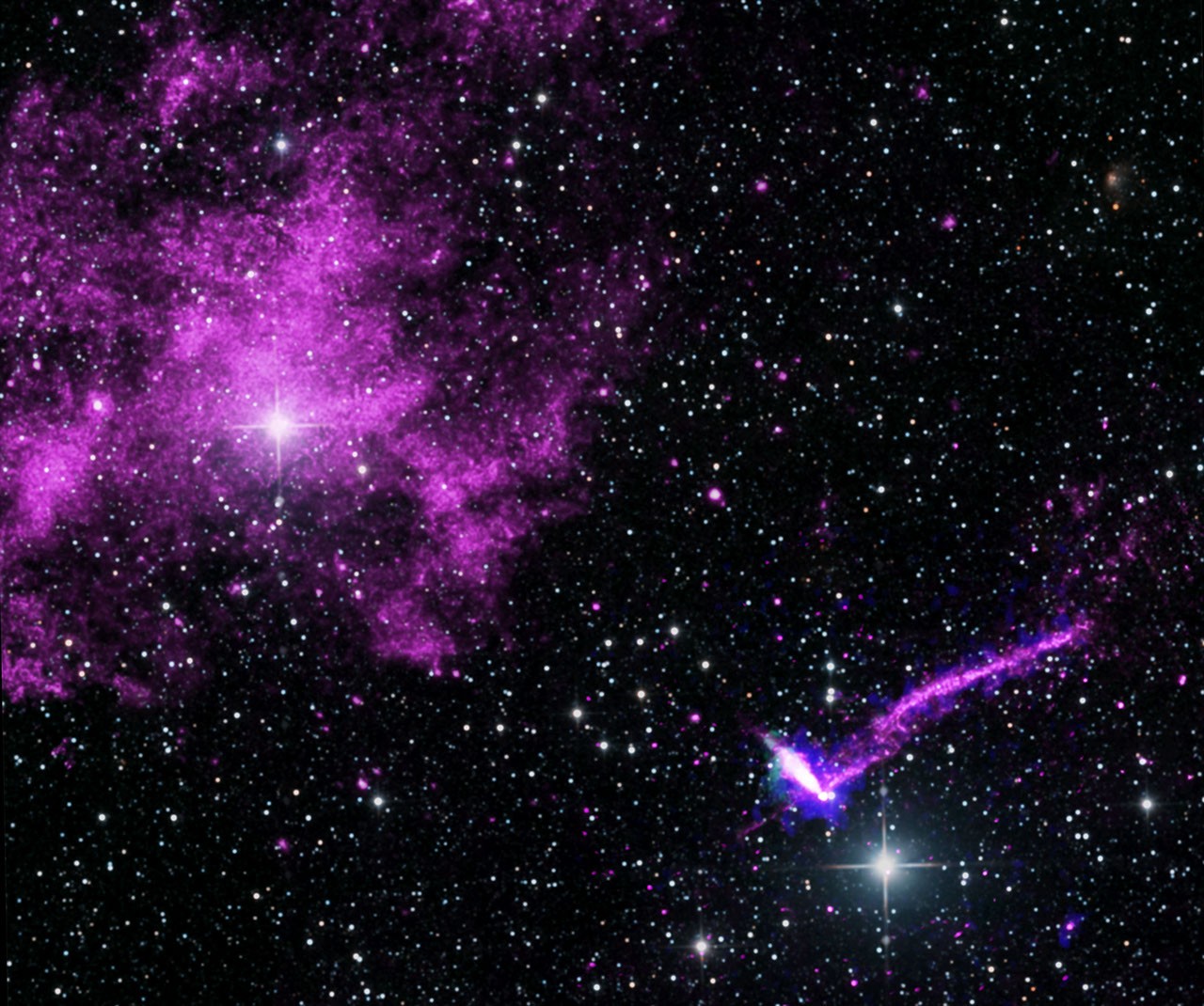
For the first time, NASA’s IXPE telescope mapped the magnetic fields of PSR J1101−6101, a pulsar embedded in the Lighthouse Nebula, using 18 days of observations in June 2025. The study focused on two X-ray structures: a long filament and a shorter trail, both formed by high-energy particles interacting with interstellar gas. Researchers aimed to confirm whether particles escaping the pulsar’s bow shock follow the nebula’s magnetic field lines, as previously theorized since 2008. The findings provide direct evidence of this alignment, supporting existing models of particle motion in such systems.
The team, led by Stanford University graduate student Jack Dinsmore, measured the polarization of light from the filament, trail, and pulsar itself to determine magnetic field direction. Advanced analysis techniques were required due to the nebula’s faintness, ensuring no data was discarded. The results confirmed with over 99% confidence that the filament’s particles flow along the magnetic field, though the high polarization degree suggested lower turbulence than some models predicted. This discrepancy raises new questions about the energy distribution within the nebula.
Additional observations revealed a striking contrast between magnetic field orientations at different wavelengths. While IXPE’s X-ray data showed the magnetic field parallel to the trail, radio frequency observations indicated a perpendicular alignment. Niccolò Bucciantini of the Italian National Institute for Astrophysics noted this divergence suggests particles of varying energies occupy distinct regions within the system, implying multiple acceleration mechanisms are at play.
The findings, published Thursday in the Astrophysical Journal, highlight the capabilities of IXPE, NASA’s first mission dedicated to X-ray polarization studies. The mission, a collaboration between NASA and the Italian Space Agency with partners in 12 countries, is led by NASA’s Marshall Space Flight Center and managed by BAE Systems and the University of Colorado. The results underscore the structured complexity of pulsar systems and open new avenues for understanding how extreme cosmic objects generate and distribute energy.