NASA’s Webb Captures Commotion From Nebula’s Stellar Jets
NASA’s James Webb Space Telescope reveals hidden stars and dynamic processes in the stellar nursery NGC 7129, offering new insights into star formation and molecular cloud evolution.
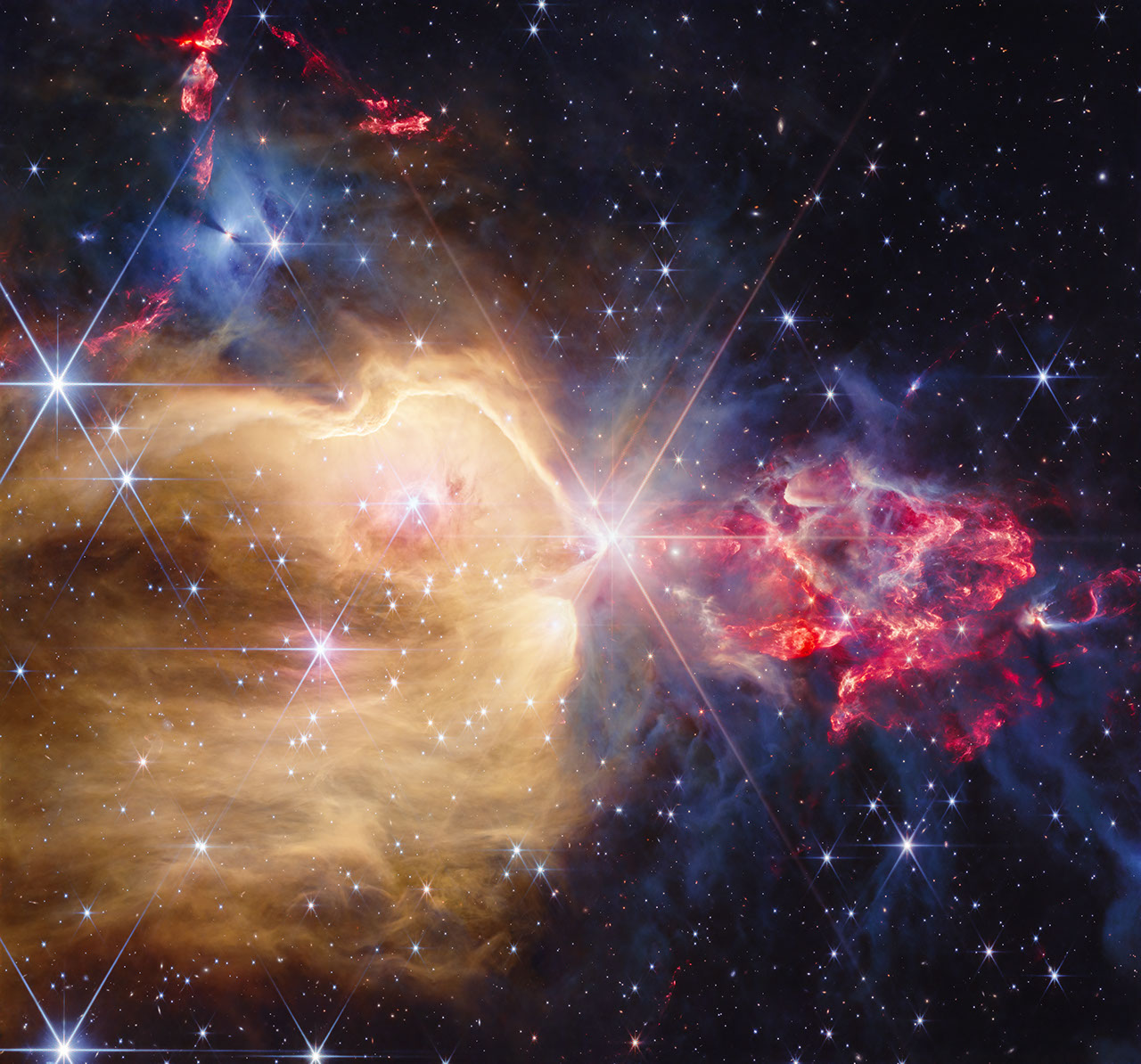
NASA’s James Webb Space Telescope has captured a detailed image of the stellar nursery NGC 7129, located approximately 3,300 light-years from Earth. The image exposes previously hidden stars enveloped in dust clouds, which are difficult to observe with visible-light telescopes. Webb’s infrared sensitivity allows astronomers to study the early stages of star formation, revealing a cluster of stars at different developmental phases.
The central star, LkH(alpha) 234, is a pre-main-sequence star weighing between 5 to 8 times the mass of the Sun. Its outflows have carved a 3.5-light-year cavity in the surrounding molecular hydrogen cloud, compressing gas and triggering further star formation. The star’s light and stellar winds energize the gas, creating glowing regions and smaller cavities from younger stars within the cavity.
To the right of the central star, a red-hued region reveals protostars, which are younger than pre-main-sequence stars. These protostars eject superheated material, interacting with dense gas to produce shocks and a textured appearance. Multiple overlapping outflows contribute to the chaotic visual, while a blue nebula near the upper left hosts a protostar surrounded by a donut-shaped disk casting a shadow.
Webb’s high-resolution imaging surpasses previous observations by NASA’s retired Spitzer Space Telescope, uncovering intricate gas and dust filaments and numerous background galaxies. The data will help astronomers understand how stars and protostars influence their surrounding molecular clouds over millions of years.