Colorful Collage of Tarantula Nebula
NASA released a composite image of the Tarantula Nebula on August 11, 2026, combining data from Chandra, Webb, and Hubble telescopes to study its energy loss mechanisms.
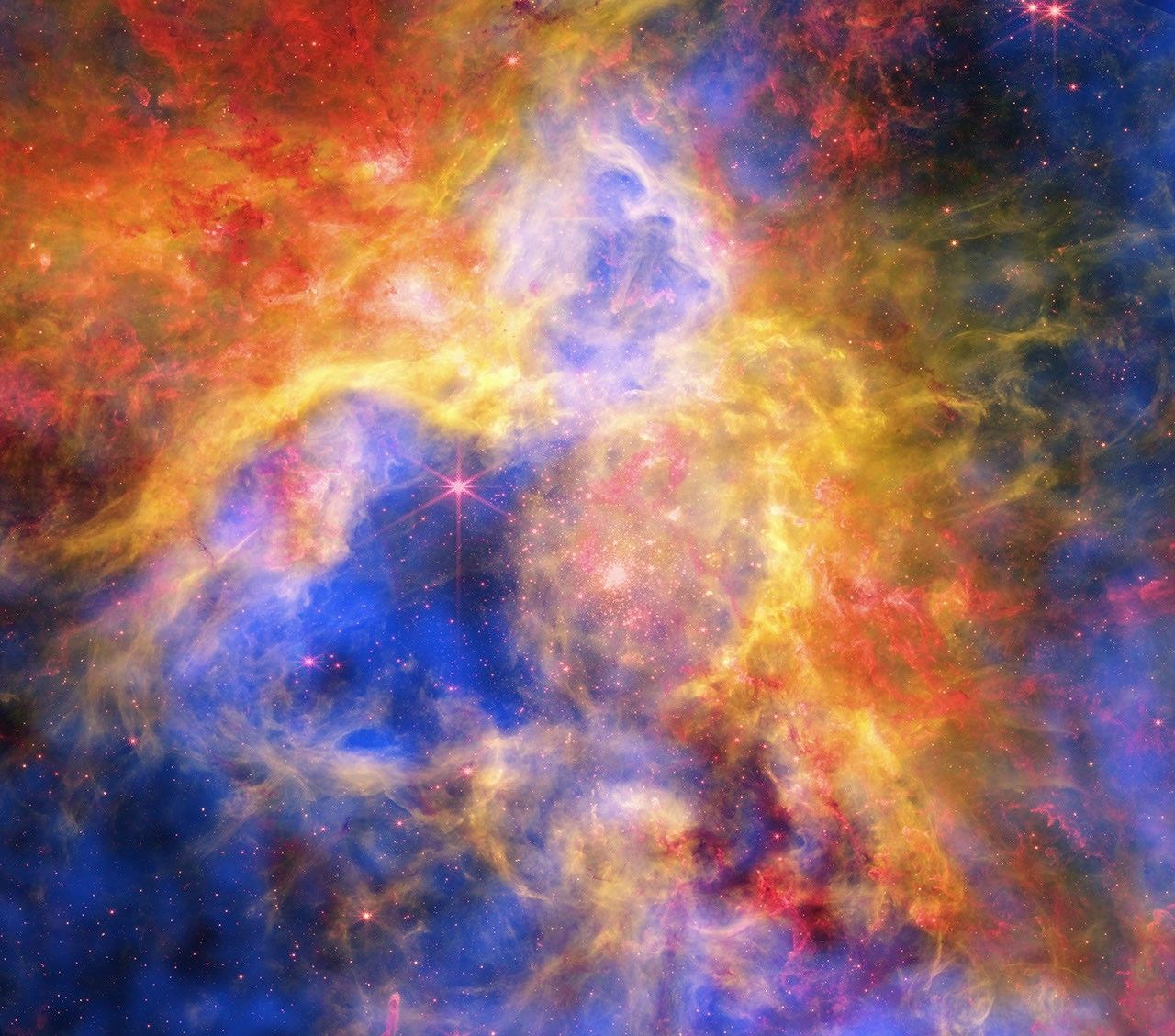
NASA unveiled a new image of the Tarantula Nebula on August 11, 2026, created by merging observations from the Chandra X-ray Observatory, the James Webb Space Telescope, and the Hubble Space Telescope. The composite image highlights the nebula’s intricate structure of gas and dust, located in the Large Magellanic Cloud, approximately 160,000 light-years from Earth. The nebula contains thousands of young stars embedded within its honeycomb-like formation, offering astronomers a detailed view of stellar activity and interstellar material. This multi-wavelength approach provides deeper insights into the nebula’s composition and behavior than single-telescope observations alone.
Astronomers analyzed data from Chandra, Hubble, and Webb, along with archival observations from the retired Spitzer Space Telescope, to investigate energy dynamics within the Tarantula Nebula. The study revealed that the nebula may be losing energy through multiple processes, including the escape of hot gas from its structure. These findings contribute to understanding how such nebulae evolve and interact with their surrounding environments over time. The research underscores the value of combining data from different telescopes to uncover complex astrophysical phenomena. The Large Magellanic Cloud serves as a key laboratory for studying star formation and nebular processes due to its proximity and observable features.
The Tarantula Nebula, one of the most active star-forming regions in the Local Group of galaxies, has long been a focus of astronomical research. Its dense concentrations of young stars and turbulent gas make it an ideal target for studying the life cycles of massive stars and the impact of stellar winds on interstellar material. The new composite image enhances previous observations by providing a more comprehensive view of the nebula’s structure and energy distribution. Researchers anticipate that these findings will inform future studies of similar regions in other galaxies, offering broader insights into galactic evolution.
The collaborative effort between NASA’s Chandra, Webb, and Hubble telescopes demonstrates the agency’s commitment to advancing astrophysical research through multi-mission data integration. By leveraging the unique capabilities of each observatory, scientists can address questions that single instruments cannot. The Tarantula Nebula’s energy loss mechanisms, as revealed in this study, highlight the dynamic processes shaping nebulae and influencing star formation. This work also serves as a testament to the enduring scientific value of archival data from retired missions like Spitzer, which continue to support ongoing discoveries.