NASA Telescopes Create Colorful ‘Craft’ From Nearby Nebula
NASA telescopes combine data to reveal new details about the Tarantula Nebula, showing how energy from young stars escapes and cools the region.
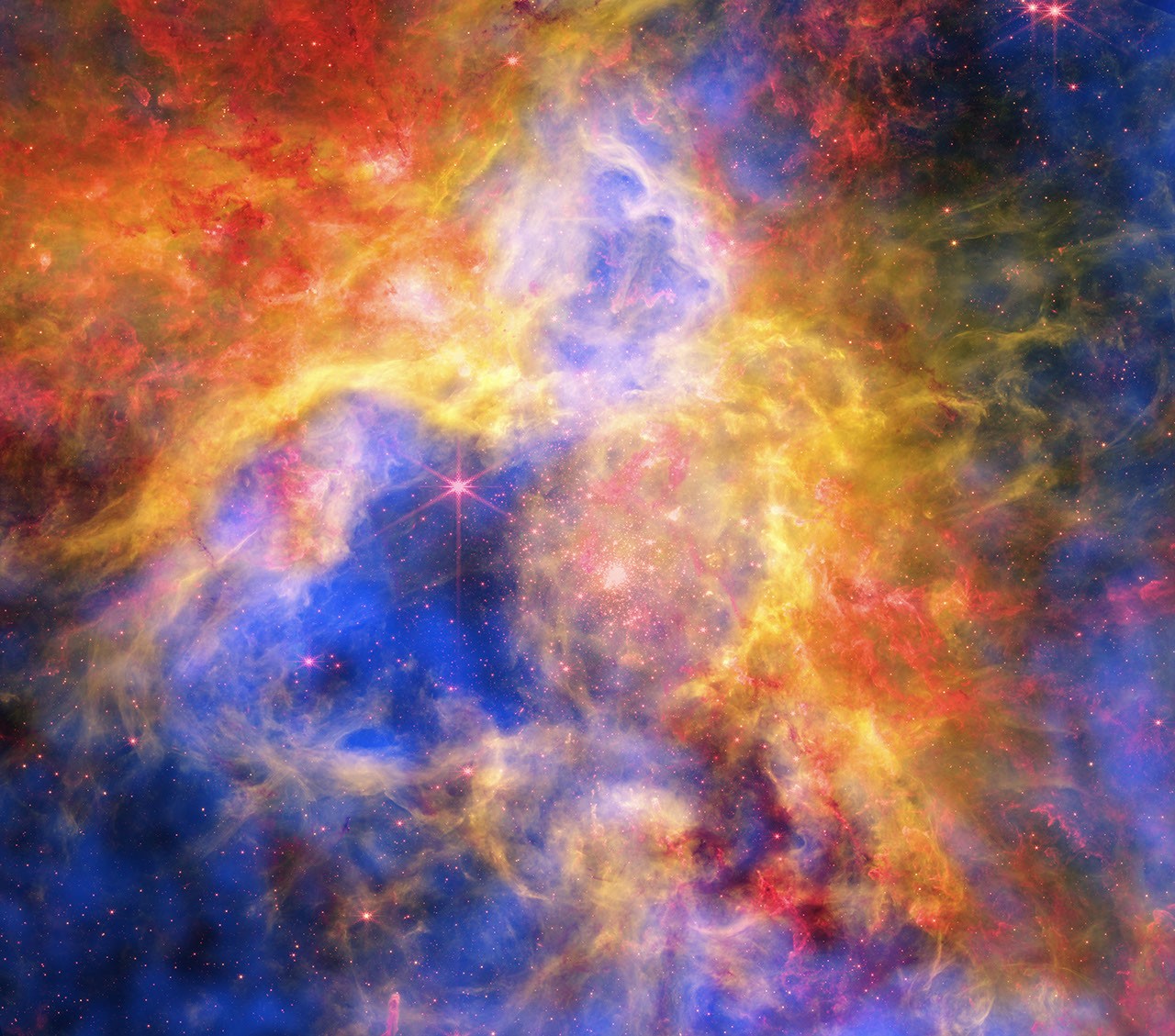
NASA has released a composite image of the Tarantula Nebula, combining X-ray, infrared, and optical data from the Chandra, Webb, and Hubble telescopes. The nebula, located 160,000 light-years away in the Large Magellanic Cloud, hosts thousands of young stars embedded in gas and dust. The image layers blue X-ray data from Chandra, red infrared data from Webb, and green optical data from Hubble to highlight different components of the region.
Researchers led by Jennifer Rodriguez of The Ohio State University analyzed the combined data to study energy from winds of young, massive stars. They found less X-ray-emitting gas than expected, indicating the nebula is losing energy through multiple processes. Up to half of the hot gas escapes through shell walls, while stirring and mixing with cooler gas lowers temperatures, and conduction transfers heat to denser regions.
The study, published in the Astrophysical Journal, suggests these energy-loss mechanisms explain the nebula’s complex structure. The team used additional data from NASA’s retired Spitzer Space Telescope and computer simulations to reach their conclusions. The findings provide new insights into how star-forming regions regulate energy and cool over time.
The paper includes contributions from scientists at multiple institutions, including Columbia University and the Space Telescope Science Institute. NASA’s Marshall Space Flight Center manages the Chandra program, while the Smithsonian Astrophysical Observatory oversees its science and flight operations. The Hubble and Webb telescopes continue to expand our understanding of the universe through coordinated observations.