NASA’s Hubble Spies Spiral’s Edge
NASA’s Hubble Space Telescope captured an edge-on view of the spiral galaxy NGC 1827 as part of a survey examining 260 satellite galaxies around Milky Way-like hosts.
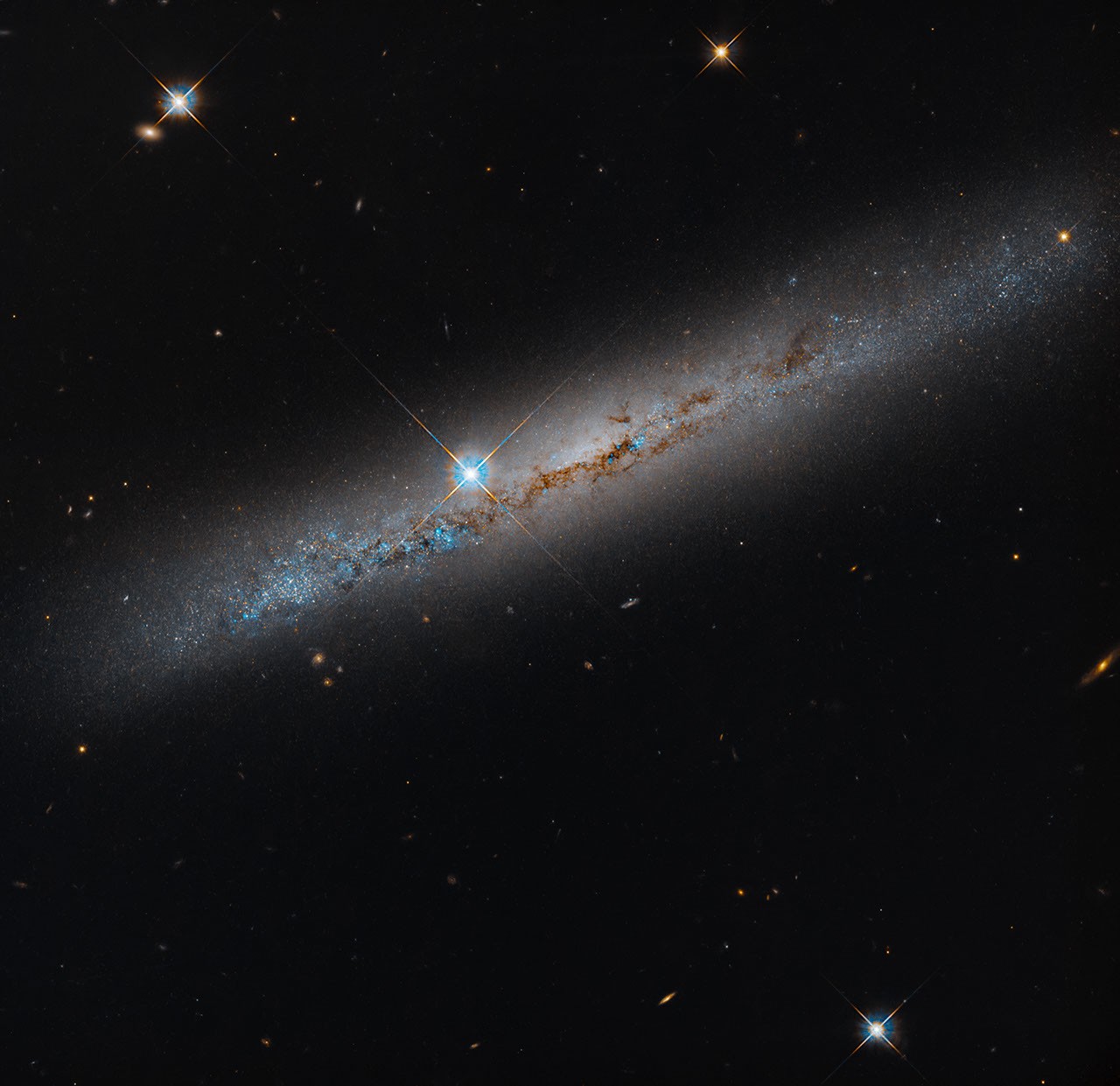
The image shows the intermediate spiral galaxy NGC 1827, positioned roughly 37 million light-years away in the constellation Columba. Hubble photographed the galaxy as part of a broader survey targeting 260 satellite galaxies orbiting 22 Milky Way-like host galaxies within 32 million light-years of Earth. The survey aims to analyze low-mass galaxies to test predictions of cosmological models on small scales, where current theories often fail to align with observations.
Hubble has already observed 111 of the 260 target satellite galaxies, with the remaining 149 requiring an additional 149 orbits—one orbit per galaxy—to complete the survey. The data collected will help researchers better characterize the properties of these low-mass galaxies within Milky Way-like systems, refining existing cosmological models.
Since its launch in 1990, the Hubble Space Telescope has fundamentally reshaped humanity’s understanding of the universe. Its observations have led to numerous scientific breakthroughs across diverse fields of astronomy. The telescope’s contributions span from discovering dark energy to mapping the distribution of dark matter.
The survey is part of Hubble’s ongoing mission to explore galaxies in unprecedented detail. The telescope’s iconic images have provided insights into galaxy formation, evolution, and structure, while also documenting its own servicing missions and operational milestones in space.