NASA’s Hubble Spots an Out-of-Sync Galaxy
NASA’s Hubble Space Telescope captured NGC 4698, a spiral galaxy 55 million light-years away, exhibiting unusual structural and rotational misalignment in its central region.
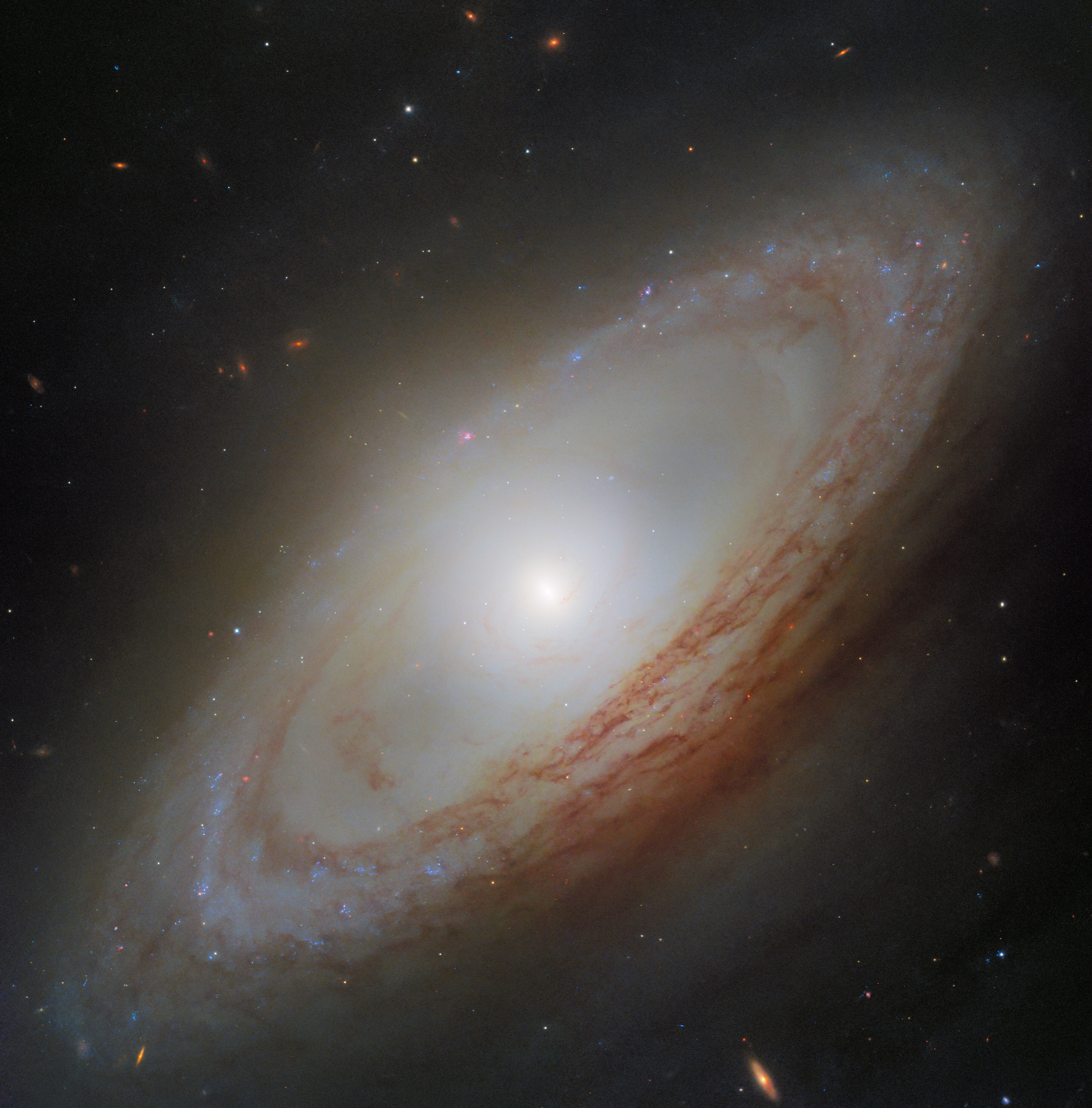
NASA’s Hubble Space Telescope has captured an image of NGC 4698, a spiral galaxy located approximately 55 million light-years away in the Virgo constellation. The galaxy is part of the Virgo Cluster, a large collection of gravitationally bound galaxies. Unlike typical spiral galaxies, NGC 4698’s spiral arms are confined to the outer disk, avoiding the central region and forming a ring-like structure around the perimeter.
The galaxy’s center features an elongated bulge composed of older, cooler stars orbiting a supermassive black hole with millions of times the Sun’s mass. Scientists have observed signs that this black hole is actively growing, pulling in gas through gravitational forces. The bulge extends at a right angle to the galaxy’s disk, a rare characteristic seen in only a few known spiral galaxies.
Astronomers suggest that NGC 4698’s unusual alignment may result from gas funneled in from an external source, creating a misaligned disk of gas and stars near the center. Observations reveal a short ‘tail’ of hydrogen streaming from one side of the galaxy, hinting at a past minor galactic merger.
Since its 1990 launch, the Hubble Space Telescope has significantly advanced our understanding of galaxies, their formation, and composition. Hubble’s observations of NGC 4698 provide further insight into the dynamic processes shaping spiral galaxies and their central structures.