Hubble Spies One-Sided Spiral
NASA’s Hubble Space Telescope captured NGC 4654, a spiral galaxy in the Virgo Cluster, displaying an asymmetric shape due to ram pressure stripping and past gravitational interactions.
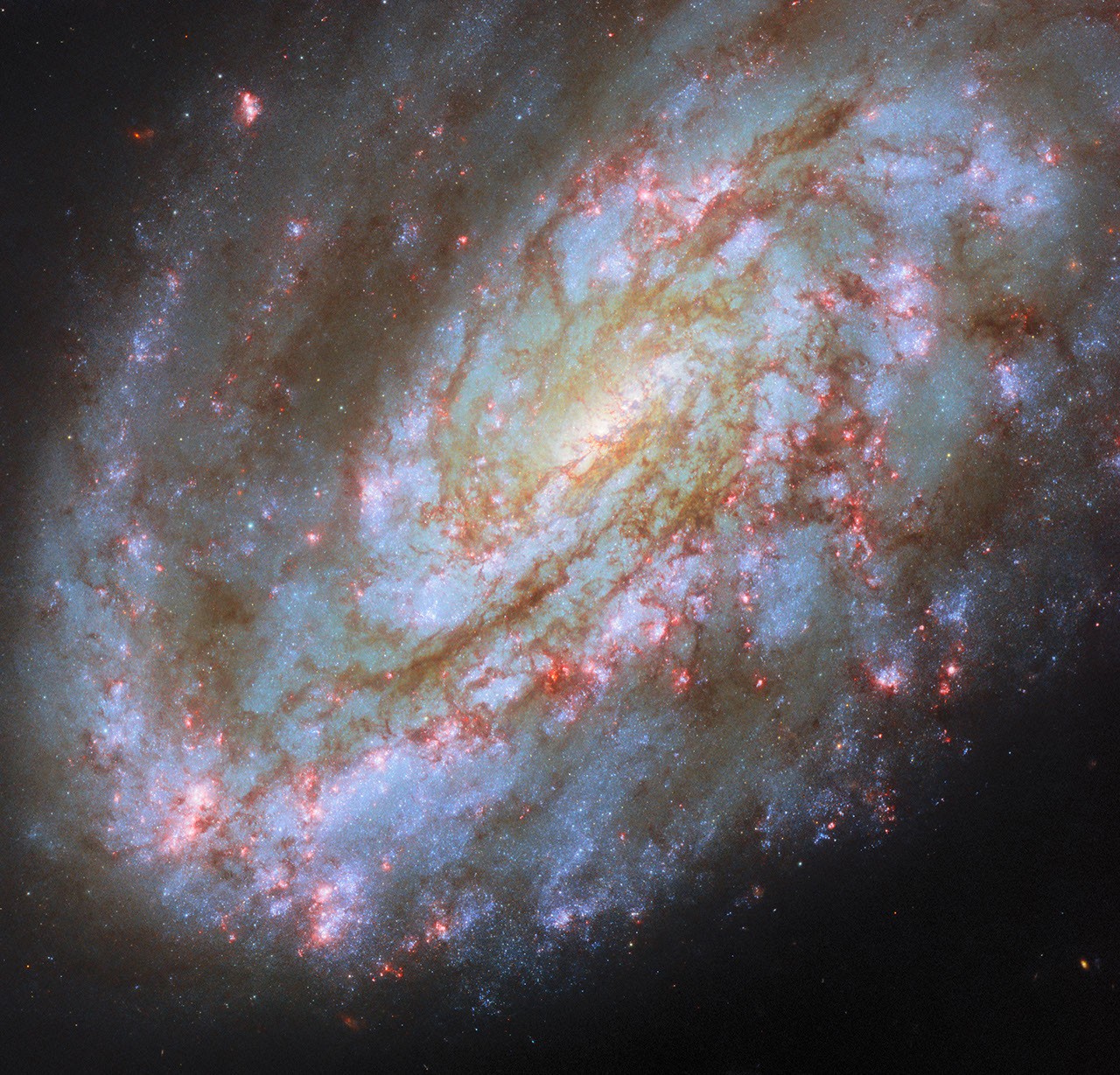
The Hubble Space Telescope has imaged NGC 4654, a spiral galaxy in the Virgo Cluster, revealing a pronounced asymmetry with one side sharply defined and the opposite side extending a long gaseous tail. This tail results from ram pressure stripping, where the galaxy’s high velocity through the cluster’s diffuse gas compresses its leading edge and drags gas behind it. The galaxy’s stars are also unevenly distributed, with the trailing side notably lacking stellar material, contributing to its lopsided appearance.
Astronomers attribute the galaxy’s irregular structure to a combination of ram pressure stripping and a past gravitational interaction with nearby galaxy NGC 4639 around 500 million years ago. This encounter is believed to have stripped gas from NGC 4654 along one side, reducing star formation there and creating its asymmetric spiral shape. Despite this disruption, the galaxy continues to form stars at a rate of nearly two solar masses per year, comparable to similar-sized galaxies.
The latest Hubble data highlights active star-forming regions in NGC 4654, visible as bright pink bubbles across its spiral arms and disk. These regions emit red light from energized gas clouds where new stars are born, providing insight into the galaxy’s ongoing stellar production. The observations are part of two Hubble programs (#15654, #17502) investigating the relationship between gas dynamics and star formation in nearby galaxies.
Since its 1990 launch, the Hubble Space Telescope has transformed our understanding of the universe by capturing detailed images of galaxies and their processes. The data from NGC 4654 contributes to broader research on how gas moves within galaxies, where it collapses to form stars, and the impact of those stars on their surroundings.