NASA’s Chandra Breaks Down ‘Treble Clef’s’ Galaxy Cluster Collision
NASA’s Chandra X-ray Observatory reveals the ‘Treble Clef’ radio formation is caused by a supermassive black hole outburst and a galaxy cluster collision, obscured by the Milky Way’s plane.
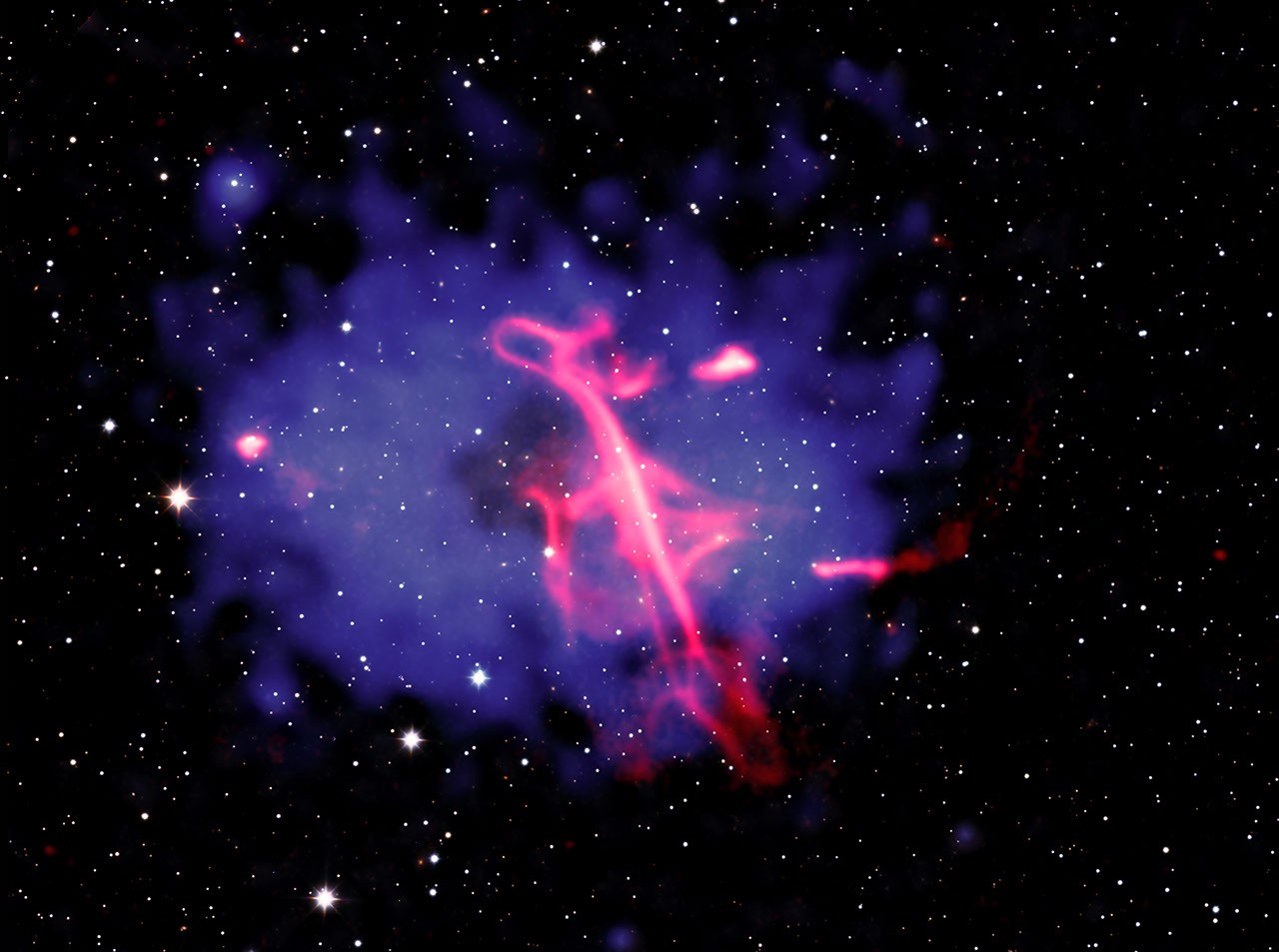
Astronomers using NASA’s Chandra X-ray Observatory have identified the cause of a radio wave formation resembling a treble clef musical symbol, located behind the Milky Way’s plane. The structure, nicknamed the ‘Treble Clef,’ is attributed to an outburst from a supermassive black hole followed by the collision of two galaxy clusters. The discovery was made possible by telescopes capable of penetrating the dense material blocking the view from Earth.
The research, led by Andrea Botteon of Italy’s National Institute for Astrophysics (INAF), was published Wednesday in the journal Astronomy & Astrophysics. Observations from Chandra and the German eROSITA X-ray telescope revealed diffuse, hot gas at the site, confirming the presence of a galaxy cluster hosting the object. The cluster was determined to be two merging clusters, some of the largest structures in the universe.
The composite image combines X-ray data from Chandra and eROSITA (blue), radio data from LOFAR (red), and infrared data from the United Kingdom Infrared Telescope (white). The treble clef shape is a result of a two-stage process: an earlier black hole outburst drove charged particles and magnetic fields outward, producing bright radio waves that faded over time before being reenergized by the cluster collision.
To confirm the collision, researchers used a technique to isolate asymmetrical X-ray emissions in the cluster’s hot gas. The residual image showed brighter emissions on the left and right, indicating the collision occurred along that axis. The clusters are now moving apart after colliding a few hundred million years ago, with the treble clef shape resulting from pareidolia.