NASA’s Chandra Unveils Mysterious X-Ray Objects
NASA’s Chandra X-ray Observatory has identified 84 unusual objects in six galaxies emitting low-energy X-rays and intense ultraviolet radiation, potentially solving two long-standing astrophysical puzzles.
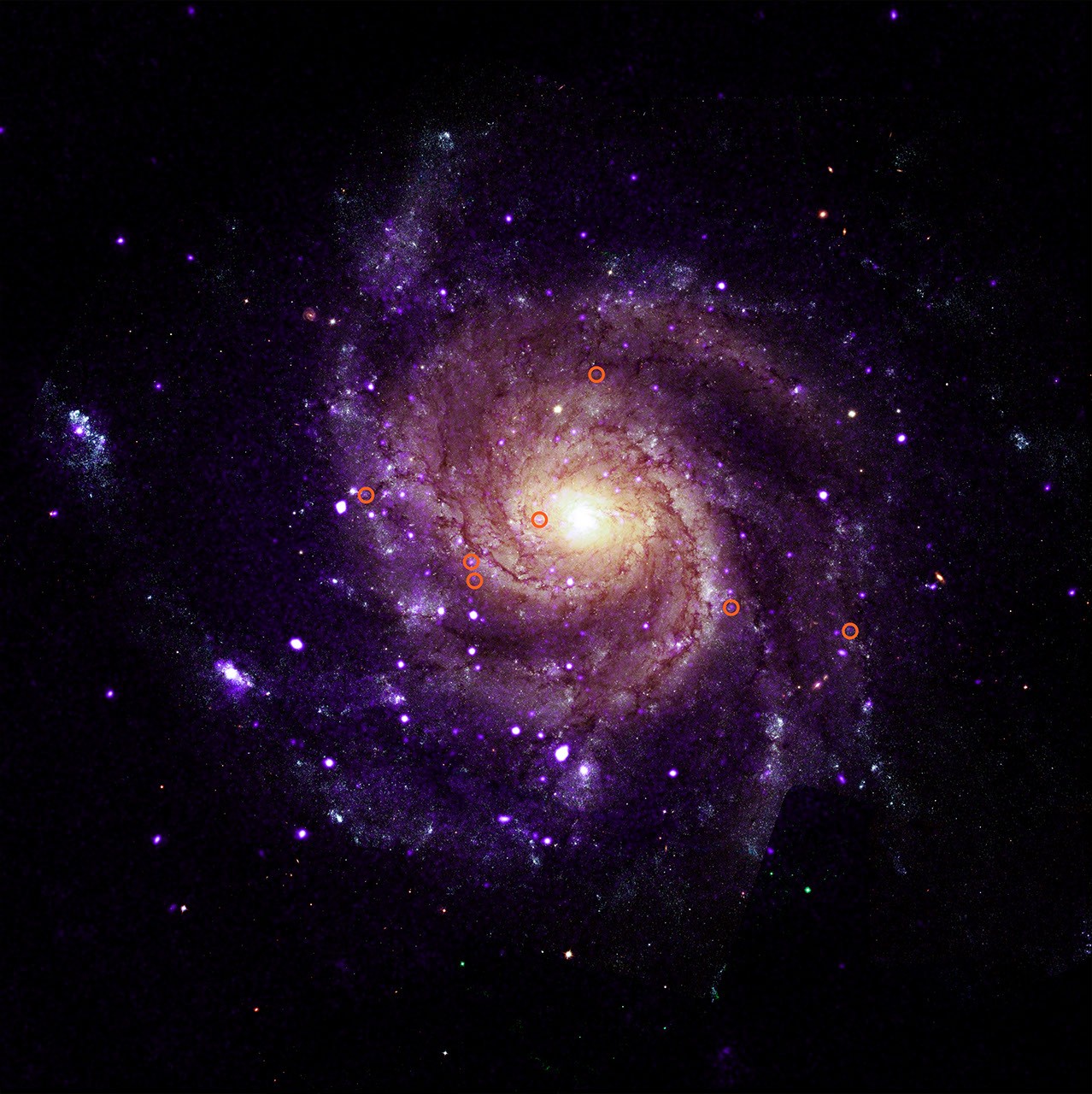
Astronomers using NASA’s Chandra X-ray Observatory have detected 84 objects in six galaxies that emit unusually low-energy X-rays alongside intense ultraviolet radiation, a behavior unlike any previously observed. These objects, termed 'hypersoft X-ray sources,' were found in both spiral and elliptical galaxies, including Andromeda and the Pinwheel galaxy. The discovery challenges existing models of stellar phenomena and may provide new insights into cosmic processes. Researchers emphasize that these objects were overlooked until now due to their faint X-ray signatures and the absorption of ultraviolet light by interstellar gas.
The team, led by Mustafa Muhibullah of the University of Alabama, identified the sources by analyzing Chandra’s lowest-energy X-ray images, where they appeared prominently, while vanishing in higher-energy images. This pattern indicates a dominance of low-energy emissions over high-energy ones. The researchers propose that these objects likely involve binary systems where a black hole, neutron star, or white dwarf strips material from a companion star, heating it to produce X-rays before it falls onto the compact object.
The discovery could help resolve two major astrophysical questions: the origin of Type Ia supernovae and the stripping of electrons from interstellar gas. Type Ia supernovae, critical for measuring the universe’s expansion, are thought to originate from white dwarf systems, but their progenitors remain unidentified. Additionally, the intense ultraviolet radiation from these objects may explain the ionization of gas between stars, a process that influences star formation and galactic evolution.
The objects were found by mining publicly available data from the Chandra archive, a method that uncovered a previously invisible class of cosmic phenomena. Co-author Rosanne Di Stefano of the Center for Astrophysics | Harvard & Smithsonian noted that this approach eliminated a long-standing blind spot in X-ray astronomy. The findings highlight the potential of archival data to reveal hidden aspects of the universe, with NASA’s Chandra program and Smithsonian Astrophysical Observatory playing key roles in the discovery.