Galactic Gems Glisten in New Gallery From NASA’s Chandra
NASA’s Chandra X-ray Observatory released a new gallery of 16 galactic images combining X-ray and optical data to study galaxy structure, evolution, and the elements essential to life.
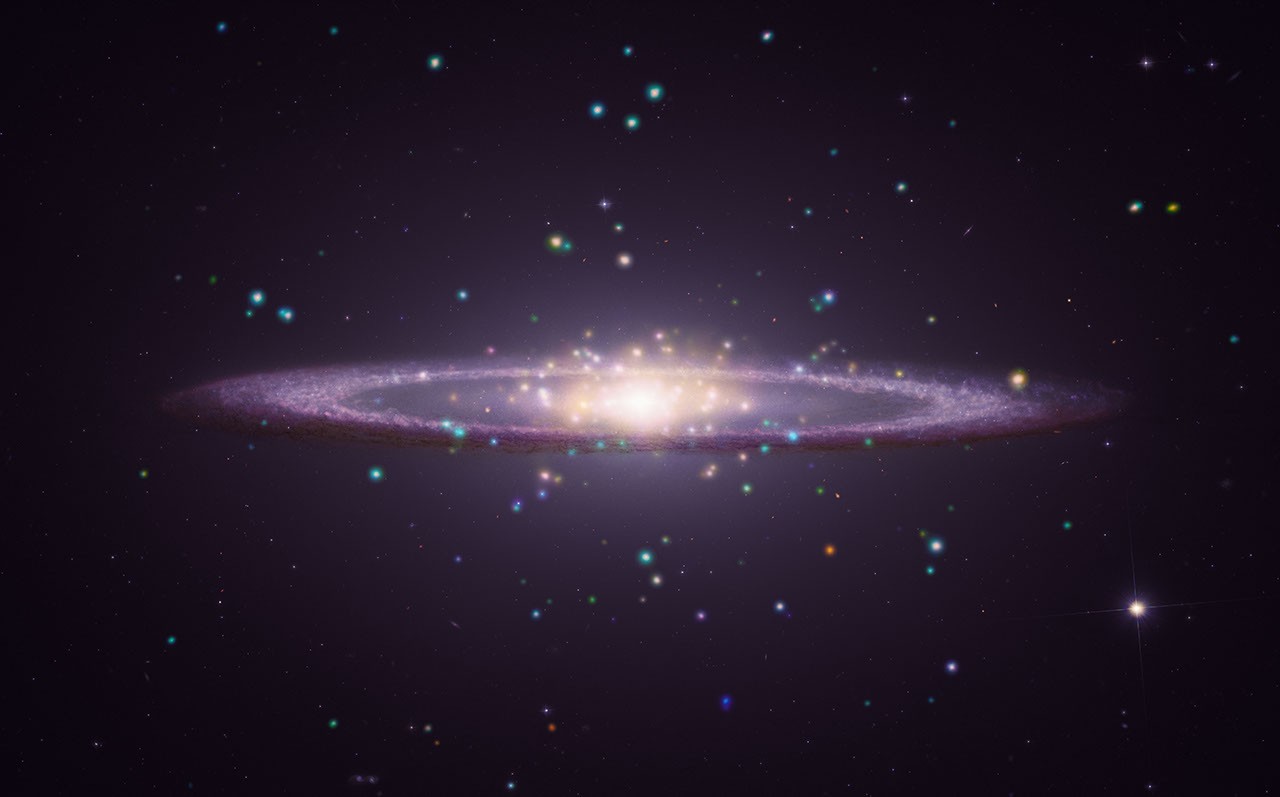
NASA’s Chandra X-ray Observatory has published a new gallery of 16 galactic images, showcasing the diversity of galaxies categorized as spirals, ellipticals, and irregulars. The images combine decades of X-ray data from Chandra with observations from telescopes including Hubble, James Webb, and IXPE. This multi-wavelength approach allows astronomers to study the life cycles of galaxies, from star formation to the influence of supermassive black holes, providing insights into the Milky Way’s past and future.
The gallery highlights phenomena such as superheated gas, outflows from black holes, and stellar explosions, which are key sources of elements found in the human body and Earth. Face-on spirals like Messier 33 reveal energetic star pairs and cosmic explosions, while barred spirals like NGC 1672 show how central bars funnel gas to trigger starbursts. Collisions, such as in NGC 4725, demonstrate how interactions shape galactic evolution and star formation patterns.
Edge-on galaxies like NGC 4631 and Messier 82 exhibit giant halos and superwinds of million-degree gas, expelled by intense stellar explosions over thousands of light-years. These outflows enrich intergalactic space with vital elements, illustrating how galaxies interact with their surroundings. Active galactic nuclei, powered by supermassive black holes, are also featured, with jets and outbursts impacting entire galaxies, as seen in Centaurus A and Messier 106.
The Chandra program is managed by NASA’s Marshall Space Flight Center, with science operations led by the Smithsonian Astrophysical Observatory’s Chandra X-ray Center. The gallery underscores the importance of X-ray astronomy in understanding cosmic phenomena, complementing data from optical and infrared telescopes to build a comprehensive picture of galactic behavior and evolution.