NASA’s Hubble Discovers First of Star Cluster’s Missing Black Holes
NASA’s Hubble and Webb telescopes have identified the first stellar-mass black hole in the Omega Centauri star cluster, resolving a long-standing astronomical mystery and advancing understanding of black hole formation.
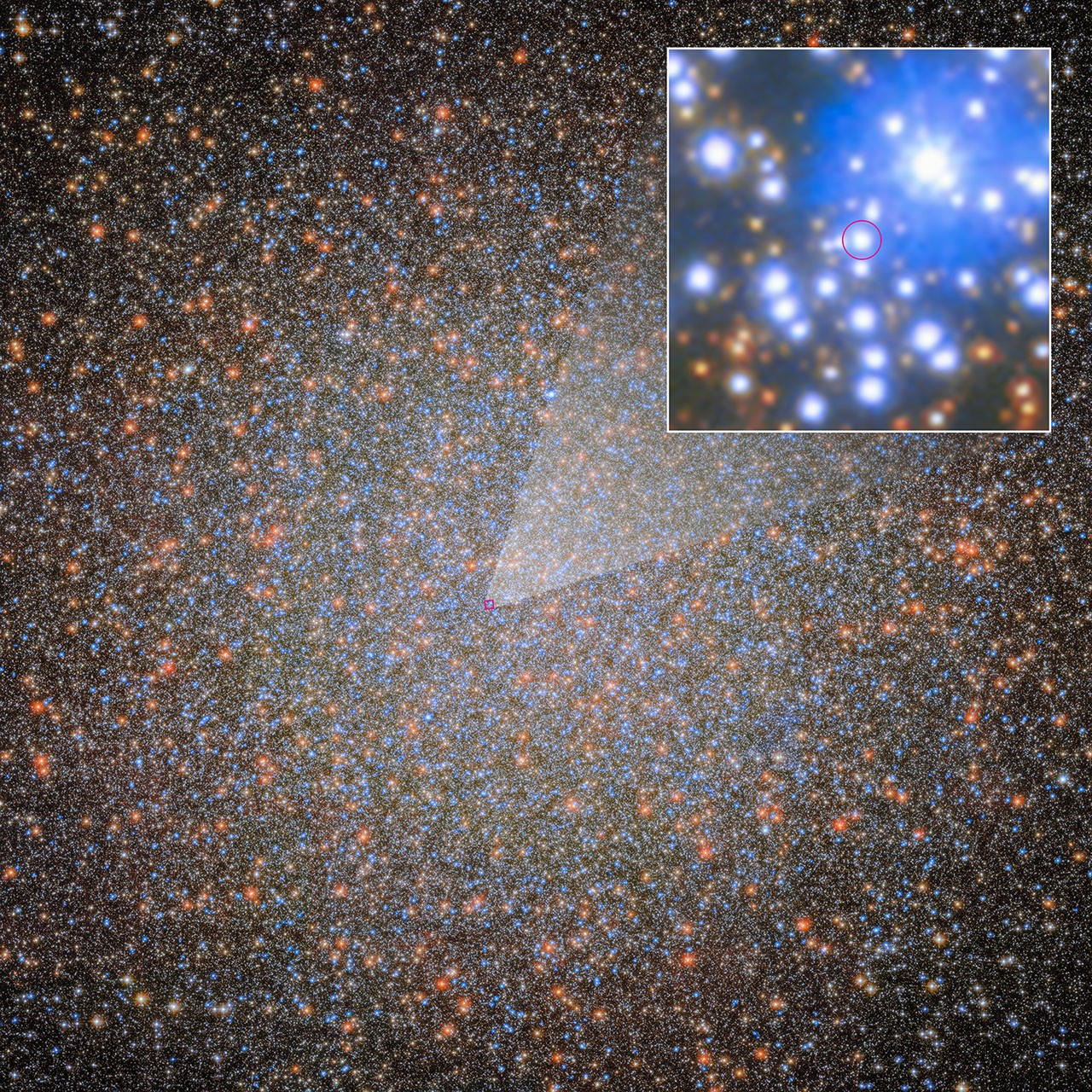
Astronomers using archival data from NASA’s Hubble Space Telescope and recent observations from the James Webb Space Telescope have located the first stellar-mass black hole in the Omega Centauri star cluster. This discovery addresses a decades-old puzzle about the absence of such black holes, which models predicted should exist in large numbers within the cluster’s 10 million stars. The finding was made possible by analyzing over 20 years of Hubble data combined with Webb’s precise measurements, using a method called astrometry to track the motion of a visible star orbiting an invisible, massive companion.
The newly detected black hole, named oMEGACat BH-2, has an unexpectedly low mass of 4.46 solar masses and forms a binary system with a visible star companion. Its orbital period of 94 years is the longest ever recorded for a black hole binary, suggesting the system formed dynamically rather than originating together. The team ruled out previous suggestions that the companion might be a neutron star by refining mass calculations using combined Hubble and Webb data from 2002 to 2023.
Researchers note that oMEGACat BH-2’s low mass in a metal-poor environment challenges existing theories of black hole formation. The discovery provides critical data for modeling how such black holes develop in dense star clusters like Omega Centauri, which is approximately 12 billion years old. The team emphasizes the importance of understanding black hole populations in these environments to interpret gravitational wave events, as globular clusters are believed to be primary sites for black hole mergers.
The discovery marks the beginning of a broader search for similar black hole systems within Omega Centauri and other globular clusters. The researchers plan to continue using Hubble and Webb data while anticipating contributions from NASA’s upcoming Nancy Grace Roman Space Telescope, which will offer high-resolution imaging over wider fields. This work underscores the ongoing role of space telescopes in advancing fundamental astrophysical research.