Starburst Galaxy Centaurus A
NASA’s James Webb Space Telescope captured a detailed mid-infrared image of the nearby galaxy Centaurus A, revealing its dusty structures and energetic activity to study galactic and black hole evolution.
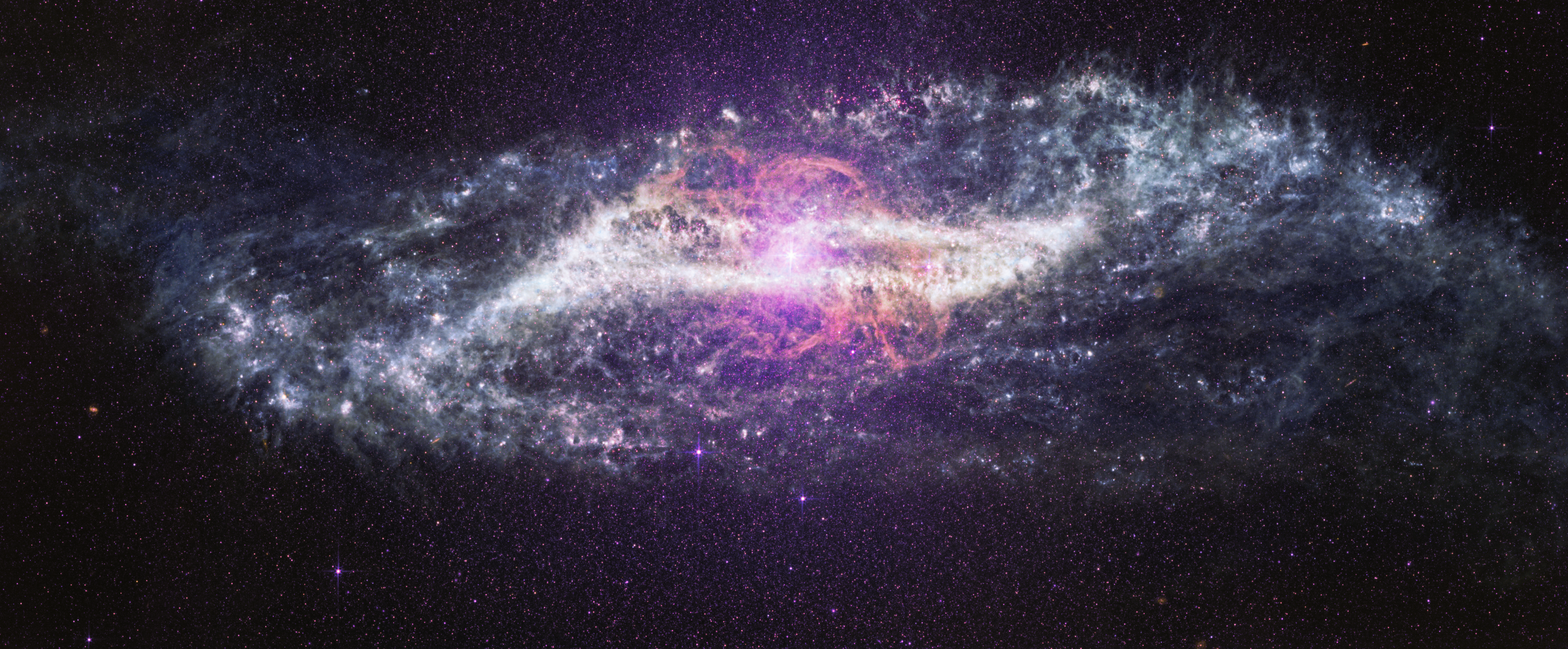
NASA’s James Webb Space Telescope, using its Mid-Infrared Instrument (MIRI), has produced a high-resolution image of Centaurus A, a galaxy located 11 million light-years from Earth. The image highlights intricate dust lanes and previously obscured regions within the galaxy, offering new insights into its complex structure. Centaurus A is classified as an active galaxy, meaning it exhibits unusually high levels of energy output compared to typical nearby galaxies. Researchers use such systems to investigate the interplay between galactic evolution and supermassive black holes at their centers.
The galaxy Centaurus A is notable for its unusual morphology, including a prominent dust lane that bisects its core. This feature is believed to result from a past merger with another galaxy, which may have triggered the intense activity observed today. The MIRI instrument’s sensitivity to mid-infrared light allows it to penetrate dust clouds, revealing hidden star-forming regions and energetic processes near the galaxy’s nucleus. These observations help scientists trace the history of star formation and black hole growth in the system.
Centaurus A serves as a key target for studying the mechanisms driving galactic activity, including jets of particles and radiation emitted by its central black hole. The James Webb Space Telescope’s data will be compared with observations from other wavelengths, such as radio and X-ray, to build a comprehensive picture of the galaxy’s behavior. This multi-wavelength approach is essential for understanding how active galaxies like Centaurus A influence their surroundings and contribute to cosmic evolution.
The new image underscores the capabilities of the James Webb Space Telescope in revealing details of nearby galaxies that were previously difficult to observe. By analyzing Centaurus A’s dust structures and energetic outflows, astronomers aim to refine models of galaxy formation and black hole dynamics. The findings may also provide context for interpreting observations of more distant and fainter galaxies, advancing our understanding of the universe’s development over time.